


Page 118 - Foundations of Cognitive Psychology : Core Readings
P. 118
Experimental Design in Psychological Research  121


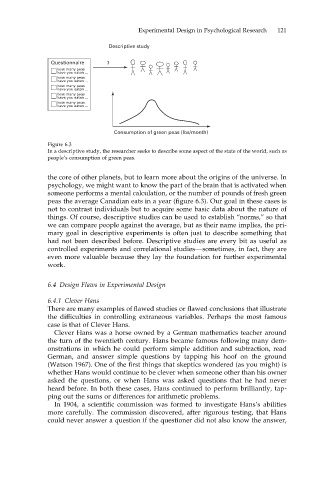
               Figure 6.3
               In a descriptive study,the researcher seeks to describe some aspect of the state of the world, such as
               people’s consumption of green peas.


               the core of other planets,but to learn more about the origins of the universe. In
               psychology,we might want to know the part of the brain that is activated when
               someone performs a mental calculation,or the number of pounds of fresh green
               peas the average Canadian eats in a year (figure 6.3). Our goal in these cases is
               not to contrast individuals but to acquire some basic data about the nature of
               things. Of course,descriptive studies can be used to establish ‘‘norms,’’ so that
               we can compare people against the average,but as their name implies,the pri-
               mary goal in descriptive experiments is often just to describe something that
               had not been described before. Descriptive studies are every bit as useful as
               controlled experiments and correlational studies—sometimes,in fact,they are
               even more valuable because they lay the foundation for further experimental
               work.


               6.4 Design Flaws in Experimental Design

               6.4.1 Clever Hans
               There are many examples of flawed studies or flawed conclusions that illustrate
               the difficulties in controlling extraneous variables. Perhaps the most famous
               case is that of Clever Hans.
                 Clever Hans was a horse owned by a German mathematics teacher around
               the turn of the twentieth century. Hans became famous following many dem-
               onstrations in which he could perform simple addition and subtraction,read
               German,and answer simple questions by tapping his hoof on the ground
               (Watson 1967). One of the first things that skeptics wondered (as you might) is
               whether Hans would continue to be clever when someone other than his owner
               asked the questions,or when Hans was asked questions that he had never
               heard before. In both these cases,Hans continued to perform brilliantly, tap-
               ping out the sums or differences for arithmetic problems.
                 In 1904,a scientific commission was formed to investigate Hans’s abilities
               more carefully. The commission discovered,after rigorous testing,that Hans
               could never answer a question if the questioner did not also know the answer,

