


Page 134 - Foundations of Cognitive Psychology : Core Readings
P. 134
138   Philip G. Zimbardo and Richard J. Gerrig

                  One very important difference is that the retinal image is two-dimensional,
                whereas the environment is three-dimensional. This difference has many con-
                sequences. For instance, compare the shapes of the physical objects in figure 7.2
                with the shapes of their corresponding retinal images. The table, rug, window,
                and picture in the real-world scene are all rectangular, but only the image of
                the window actually produces a rectangle in your retinal image. The image of
                the picture is a trapezoid, the image of the table top is an irregular four-sided
                figure, and the image of the rug is actually three separate regions with more
                than 20 different sides! Here’s our first perceptual puzzle: How do you manage
                to perceive all of these objects as simple, standard rectangles?
                  The situation is, however, even a bit more complicated. You can also notice
                that many parts of what you perceive in the room are not actually present
                in your retinal image. For instance, you perceive the vertical edge between
                the two walls as going all the way to the floor, but your retinal image of
                that edge stops at the table top. Similarly, in your retinal image parts of the
                rug are hidden behind the table; yet this does not keep you from correctly per-
                ceiving the rug as a single, unbroken rectangle. In fact, when you consider all
                the differences between the environmental objects and the images of them on
                your retina, you may be surprised that you perceive the scene as well as you
                do.
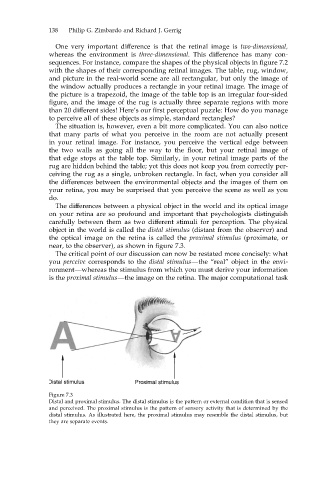
                  The differences between a physical object in the world and its optical image
                on your retina are so profound and important that psychologists distinguish
                carefully between them as two different stimuli for perception. The physical
                object in the world is called the distal stimulus (distant from the observer) and
                the optical image on the retina is called the proximal stimulus (proximate, or
                near, to the observer), as shown in figure 7.3.
                  The critical point of our discussion can now be restated more concisely: what
                you perceive corresponds to the distal stimulus—the ‘‘real’’ object in the envi-
                ronment—whereas the stimulus from which you must derive your information
                is the proximal stimulus—the image on the retina. The major computational task


                Figure 7.3
                Distal and proximal stimulus. The distal stimulus is the pattern or external condition that is sensed
                and perceived. The proximal stimulus is the pattern of sensory activity that is determined by the
                distal stimulus. As illustrated here, the proximal stimulus may resemble the distal stimulus, but
                they are separate events.

