


Page 136 - Foundations of Cognitive Psychology : Core Readings
P. 136
140   Philip G. Zimbardo and Richard J. Gerrig


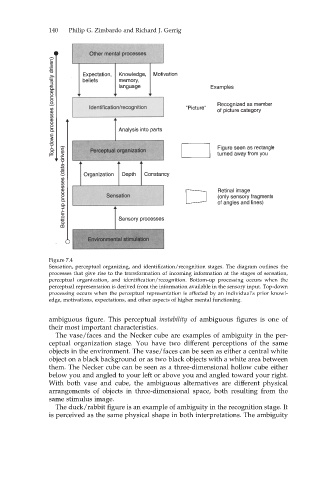
                Figure 7.4
                Sensation, perceptual organizing, and identification/recognition stages. The diagram outlines the
                processes that give rise to the transformation of incoming information at the stages of sensation,
                perceptual organization, and identification/recognition. Bottom-up processing occurs when the
                perceptual representation is derived from the information available in the sensory input. Top-down
                processing occurs when the perceptual representation is affected by an individual’s prior knowl-
                edge, motivations, expectations, and other aspects of higher mental functioning.

                ambiguous figure. This perceptual instability of ambiguous figures is one of
                their most important characteristics.
                  Thevase/facesand theNeckercubeare examples of ambiguityinthe per-
                ceptual organization stage. You have two different perceptions of the same
                objects in the environment. The vase/faces can be seen as either a central white
                object on a black background or as two black objects with a white area between
                them. The Necker cube can be seen as a three-dimensional hollow cube either
                below you and angled to your left or above you and angled toward your right.
                With both vase and cube, the ambiguous alternatives are different physical
                arrangements of objects in three-dimensional space, both resulting from the
                same stimulus image.
                  The duck/rabbit figure is an example of ambiguity in the recognition stage. It
                is perceived as the same physical shape in both interpretations. The ambiguity

