


Page 138 - Foundations of Cognitive Psychology : Core Readings
P. 138
142   Philip G. Zimbardo and Richard J. Gerrig

                arises in determining the kind of object it represents and in how best to classify
                it, given the mixed set of information available.
                  One of the most fundamental properties of normal human perception is the
                tendency to transform ambiguity and uncertainty about the environment into a
                clear interpretation that you can act upon with confidence. In a world filled
                with variability and change, your perceptual system must meet the challenges
                of discovering invariance and stability.
                Illusions  Ambiguous stimuli present your perceptual systems with the chal-
                lenge of recognizing one unique figure out of several possibilities. One or
                another interpretation of the stimulus is correct or incorrect with respect to a
                particular context. When your perceptual systems actually deceive you into
                experiencing a stimulus pattern in a manner that is demonstrably incorrect, you
                are experiencing an illusion.The word illusion shares thesameroot as ludi-
                crous—bothstemfromthe Latin illudere, which means ‘‘to mock at.’’ Illusions
                are shared by most people in the same perceptual situation because of shared
                physiology in sensory systems and overlapping experiences of the world. (This
                sets illusions apart from hallucinations. Hallucinations are nonshared perceptual
                distortions that individuals experience as a result of unusual physical or mental
                states.) Examine the classic illusions in figure 7.7. Although it is most conve-
                nient for us to present you with visual illusions, illusions also exist abundantly
                in other sensory modalities such as hearing (Bregman, 1981; Shepard & Jordan,
                1984) and taste (Todrank & Bartoshuk, 1991).
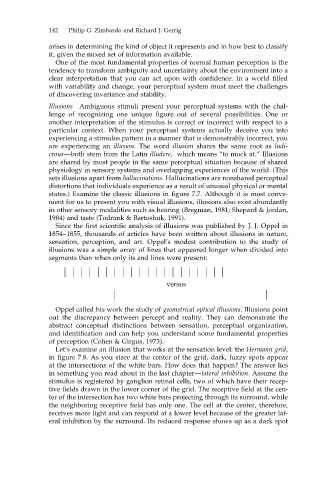
                  Since the first scientific analysis of illusions was published by J. J. Oppel in
                1854–1855, thousands of articles have been written about illusions in nature,
                sensation, perception, and art. Oppel’s modest contribution to the study of
                illusions was a simple array of lines that appeared longer when divided into
                segments than when only its end lines were present:


                                                   versus


                  Oppel called his work the study of geometrical optical illusions. Illusions point
                out the discrepancy between percept and reality. They can demonstrate the
                abstract conceptual distinctions between sensation, perceptual organization,
                and identification and can help you understand some fundamental properties
                of perception (Cohen & Girgus, 1973).
                  Let’s examine an illusion that works at the sensation level: the Hermann grid,
                in figure 7.8. As you stare at the center of the grid, dark, fuzzy spots appear
                at the intersections of the white bars. How does that happen? The answer lies
                in something you read about in the last chapter—lateral inhibition. Assume the
                stimulus is registered by ganglion retinal cells, two of which have their recep-
                tive fields drawn in the lower corner of the grid. The receptive field at the cen-
                ter of the intersection has two white bars projecting through its surround, while
                the neighboring receptive field has only one. The cell at the center, therefore,
                receives more light and can respond at a lower level because of the greater lat-
                eral inhibition by the surround. Its reduced response shows up as a dark spot

