


Page 142 - Foundations of Cognitive Psychology : Core Readings
P. 142
146   Philip G. Zimbardo and Richard J. Gerrig


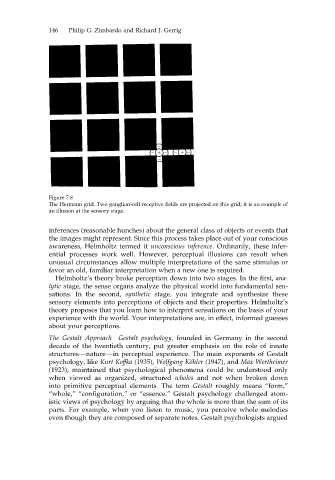
                Figure 7.8
                The Hermann grid. Two ganglion-cell receptive fields are projected on this grid; it is an example of
                an illusion at the sensory stage.


                inferences (reasonable hunches) about the general class of objects or events that
                the images might represent. Since this process takes place out of your conscious
                awareness, Helmholtz termed it unconscious inference. Ordinarily, these infer-
                ential processes work well. However, perceptual illusions can result when
                unusual circumstances allow multiple interpretations of the same stimulus or
                favor an old, familiar interpretation when a new one is required.
                  Helmholtz’s theory broke perception down into two stages. In the first, ana-
                lytic stage, the sense organs analyze the physical world into fundamental sen-
                sations. In the second, synthetic stage, you integrate and synthesize these
                sensory elements into perceptions of objects and their properties. Helmholtz’s
                theory proposes that you learn how to interpret sensations on the basis of your
                experience with the world. Your interpretations are, in effect, informed guesses
                about your perceptions.
                The Gestalt Approach  Gestalt psychology, founded in Germany in the second
                decade of the twentieth century, put greater emphasis on the role of innate
                structures—nature—in perceptual experience. The main exponents of Gestalt
                psychology, like Kurt Koffka (1935), Wolfgang Ko ¨hler (1947), and Max Wertheimer
                (1923), maintained that psychological phenomena could be understood only
                when viewed as organized, structured wholes and not when broken down
                into primitive perceptual elements. The term Gestalt roughly means ‘‘form,’’
                ‘‘whole,’’ ‘‘configuration,’’ or ‘‘essence.’’ Gestalt psychology challenged atom-
                istic views of psychology by arguing that the whole is more than the sum of its
                parts. For example, when you listen to music, you perceive whole melodies
                even though they are composed of separate notes. Gestalt psychologists argued

