


Page 147 - Foundations of Cognitive Psychology : Core Readings
P. 147
Perception  151


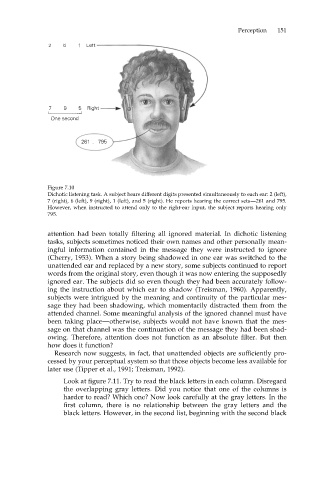
               Figure 7.10
               Dichotic listening task. A subject hears different digits presented simultaneously to each ear: 2 (left),
               7 (right), 6 (left), 9 (right), 1 (left), and 5 (right). He reports hearing the correct sets—261 and 795.
               However, when instructed to attend only to the right-ear input, the subject reports hearing only
               795.

               attention had been totally filtering all ignored material. In dichotic listening
               tasks, subjects sometimes noticed their own names and other personally mean-
               ingful information contained in the message they were instructed to ignore
               (Cherry, 1953). When a story being shadowed in one ear was switched to the
               unattended ear and replaced by a new story, some subjects continued to report
               words from the original story, even though it was now entering the supposedly
               ignored ear. The subjects did so even though they had been accurately follow-
               ing the instruction about which ear to shadow (Treisman, 1960). Apparently,
               subjects were intrigued by the meaning and continuity of the particular mes-
               sage they had been shadowing, which momentarily distracted them from the
               attended channel. Some meaningful analysis of the ignored channel must have
               been taking place—otherwise, subjects would not have known that the mes-
               sage on that channel was the continuation of the message they had been shad-
               owing. Therefore, attention does not function as an absolute filter. But then
               how does it function?
                 Research now suggests, in fact, that unattended objects are sufficiently pro-
               cessed by your perceptual system so that those objects become less available for
               later use (Tipper et al., 1991; Treisman, 1992).
                    Look at figure 7.11. Try to read the black letters in each column. Disregard
                    the overlapping gray letters. Did you notice that one of the columns is
                    harder to read? Which one? Now look carefully at the gray letters. In the
                    first column, there is no relationship between the gray letters and the
                    black letters. However, in the second list, beginning with the second black

