


Page 151 - Foundations of Cognitive Psychology : Core Readings
P. 151
Perception  155


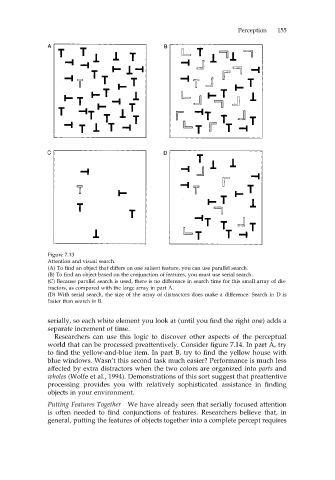
               Figure 7.13
               Attention and visual search.
               (A) To find an object that differs on one salient feature, you can use parallel search.
               (B) To find an object based on the conjunction of features, you must use serial search.
               (C) Because parallel search is used, there is no difference in search time for this small array of dis-
               tractors, as compared with the large array in part A.
               (D) With serial search, the size of the array of distractors does make a difference. Search in D is
               faster than search in B.


               serially, so each white element you look at (until you find the right one) adds a
               separate increment of time.
                 Researchers can use this logic to discover other aspects of the perceptual
               world that can be processed preattentively. Consider figure 7.14. In part A, try
               to find the yellow-and-blue item. In part B, try to find the yellow house with
               blue windows. Wasn’t this second task much easier? Performance is much less
               affected by extra distractors when the two colors are organized into parts and
               wholes (Wolfe et al., 1994). Demonstrations of this sort suggest that preattentive
               processing provides you with relatively sophisticated assistance in finding
               objects in your environment.
               Putting Features Together  We have already seen that serially focused attention
               is often needed to find conjunctions of features. Researchers believe that, in
               general, putting the features of objects together into a complete percept requires

