


Page 156 - Foundations of Cognitive Psychology : Core Readings
P. 156
160   Philip G. Zimbardo and Richard J. Gerrig


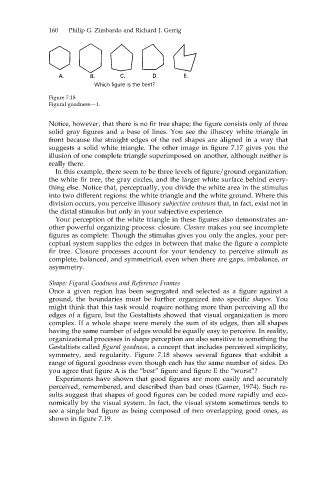
                Figure 7.18
                Figural goodness—1.


                Notice, however, that there is no fir tree shape; the figure consists only of three
                solid gray figures and a base of lines. You see the illusory white triangle in
                front because the straight edges of the red shapes are aligned in a way that
                suggests a solid white triangle. The other image in figure 7.17 gives you the
                illusion of one complete triangle superimposed on another, although neither is
                really there.
                  In this example, there seem to be three levels of figure/ground organization:
                the white fir tree, the gray circles, and the larger white surface behind every-
                thing else. Notice that, perceptually, you divide the white area in the stimulus
                into two different regions: the white triangle and the white ground. Where this
                division occurs, you perceive illusory subjective contours that, in fact, exist not in
                the distal stimulus but only in your subjective experience.
                  Your perception of the white triangle in these figures also demonstrates an-
                other powerful organizing process: closure. Closure makes you see incomplete
                figures as complete. Though the stimulus gives you only the angles, your per-
                ceptual system supplies the edges in between that make the figure a complete
                fir tree. Closure processes account for your tendency to perceive stimuli as
                complete, balanced, and symmetrical, even when there are gaps, imbalance, or
                asymmetry.

                Shape: Figural Goodness and Reference Frames
                Once a given region has been segregated and selected as a figure against a
                ground, the boundaries must be further organized into specific shapes. You
                might think that this task would require nothing more than perceiving all the
                edges of a figure, but the Gestaltists showed that visual organization is more
                complex. If a whole shape were merely the sum of its edges, then all shapes
                having the same number of edges would be equally easy to perceive. In reality,
                organizational processes in shape perception are also sensitive to something the
                Gestaltists called figural goodness, a concept that includes perceived simplicity,
                symmetry, and regularity. Figure 7.18 shows several figures that exhibit a
                range of figural goodness even though each has the same number of sides. Do
                you agree that figure A is the ‘‘best’’ figure and figure E the ‘‘worst’’?
                  Experiments have shown that good figures are more easily and accurately
                perceived, remembered, and described than bad ones (Garner, 1974). Such re-
                sults suggest that shapes of good figures can be coded more rapidly and eco-
                nomically by the visual system. In fact, the visual system sometimes tends to
                see a single bad figure as being composed of two overlapping good ones, as
                shown in figure 7.19.

