


Page 157 - Foundations of Cognitive Psychology : Core Readings
P. 157
Perception  161


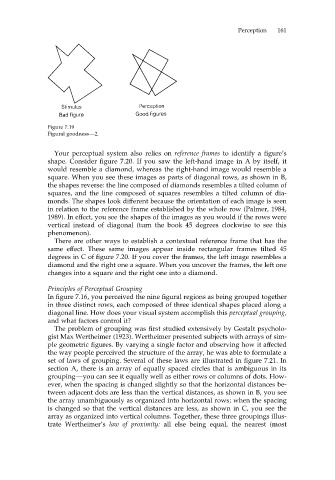
               Figure 7.19
               Figural goodness—2.

                 Your perceptual system also relies on reference frames to identify a figure’s
               shape. Consider figure 7.20. If you saw the left-hand image in A by itself, it
               would resemble a diamond, whereas the right-hand image would resemble a
               square. When you see these images as parts of diagonal rows, as shown in B,
               the shapes reverse: the line composed of diamonds resembles a tilted column of
               squares, and the line composed of squares resembles a tilted column of dia-
               monds. The shapes look different because the orientation of each image is seen
               in relation to the reference frame established by the whole row (Palmer, 1984,
               1989). In effect, you see the shapes of the images as you would if the rows were
               vertical instead of diagonal (turn the book 45 degrees clockwise to see this
               phenomenon).
                 There are other ways to establish a contextual reference frame that has the
               same effect. These same images appear inside rectangular frames tilted 45
               degrees in C of figure 7.20. If you cover the frames, the left image resembles a
               diamond and the right one a square. When you uncover the frames, the left one
               changes into a square and the right one into a diamond.

               Principles of Perceptual Grouping
               In figure 7.16, you perceived the nine figural regions as being grouped together
               in three distinct rows, each composed of three identical shapes placed along a
               diagonal line. How does your visual system accomplish this perceptual grouping,
               and what factors control it?
                 The problem of grouping was first studied extensively by Gestalt psycholo-
               gist Max Wertheimer (1923). Wertheimer presented subjects with arrays of sim-
               ple geometric figures. By varying a single factor and observing how it affected
               the way people perceived the structure of the array, he was able to formulate a
               set of laws of grouping. Several of these laws are illustrated in figure 7.21. In
               section A, there is an array of equally spaced circles that is ambiguous in its
               grouping—you can see it equally well as either rows or columns of dots. How-
               ever, when the spacing is changed slightly so that the horizontal distances be-
               tween adjacent dots are less than the vertical distances, as shown in B, you see
               the array unambiguously as organized into horizontal rows; when the spacing
               is changed so that the vertical distances are less, as shown in C, you see the
               array as organized into vertical columns. Together, these three groupings illus-
               trate Wertheimer’s law of proximity: all else being equal, the nearest (most

