


Page 161 - Foundations of Cognitive Psychology : Core Readings
P. 161
Perception  165


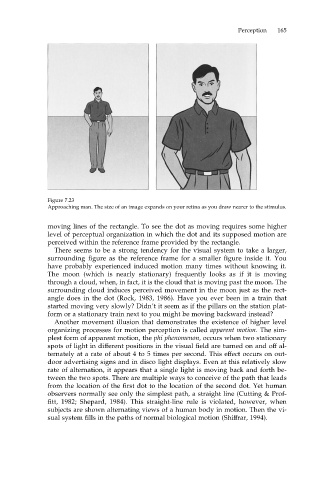
               Figure 7.23
               Approaching man. The size of an image expands on your retina as you draw nearer to the stimulus.


               moving lines of the rectangle. To see the dot as moving requires some higher
               level of perceptual organization in which the dot and its supposed motion are
               perceived within the reference frame provided by the rectangle.
                 There seems to be a strong tendency for the visual system to take a larger,
               surrounding figure as the reference frame for a smaller figure inside it. You
               have probably experienced induced motion many times without knowing it.
               The moon (which is nearly stationary) frequently looks as if it is moving
               through a cloud, when, in fact, it is the cloud that is moving past the moon. The
               surrounding cloud induces perceived movement in the moon just as the rect-
               angle does in the dot (Rock, 1983, 1986). Have you ever been in a train that
               started moving very slowly? Didn’t it seem as if the pillars on the station plat-
               form or a stationary train next to you might be moving backward instead?
                 Another movement illusion that demonstrates the existence of higher level
               organizing processes for motion perception is called apparent motion. The sim-
               plest form of apparent motion, the phi phenomenon, occurs when two stationary
               spots of light in different positions in the visual field are turned on and off al-
               ternately at a rate of about 4 to 5 times per second. This effect occurs on out-
               door advertising signs and in disco light displays. Even at this relatively slow
               rate of alternation, it appears that a single light is moving back and forth be-
               tween the two spots. There are multiple ways to conceive of the path that leads
               from the location of the first dot to the location of the second dot. Yet human
               observers normally see only the simplest path, a straight line (Cutting & Prof-
               fitt, 1982; Shepard, 1984). This straight-line rule is violated, however, when
               subjects are shown alternating views of a human body in motion. Then the vi-
               sual system fills in the paths of normal biological motion (Shiffrar, 1994).

