


Page 165 - Foundations of Cognitive Psychology : Core Readings
P. 165
Perception  169


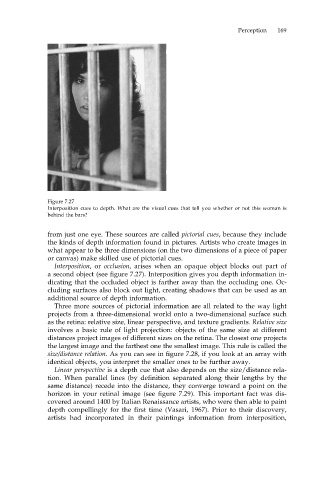
               Figure 7.27
               Interposition cues to depth. What are the visual cues that tell you whether or not this woman is
               behind the bars?

               from just one eye. These sources are called pictorial cues, because they include
               the kinds of depth information found in pictures. Artists who create images in
               what appear to be three dimensions (on the two dimensions of a piece of paper
               or canvas) make skilled use of pictorial cues.
                 Interposition,or occlusion, arises when an opaque object blocks out part of
               a second object (see figure 7.27). Interposition gives you depth information in-
               dicating that the occluded object is farther away than the occluding one. Oc-
               cluding surfaces also block out light, creating shadows that can be used as an
               additional source of depth information.
                 Three more sources of pictorial information are all related to the way light
               projects from a three-dimensional world onto a two-dimensional surface such
               as the retina: relative size, linear perspective, and texture gradients. Relative size
               involves a basic rule of light projection: objects of the same size at different
               distances project images of different sizes on the retina. The closest one projects
               the largest image and the farthest one the smallest image. This rule is called the
               size/distance relation. As you can see in figure 7.28, if you look at an array with
               identical objects, you interpret the smaller ones to be further away.
                 Linear perspective is a depth cue that also depends on the size/distance rela-
               tion. When parallel lines (by definition separated along their lengths by the
               same distance) recede into the distance, they converge toward a point on the
               horizon in your retinal image (see figure 7.29). This important fact was dis-
               covered around 1400 by Italian Renaissance artists, who were then able to paint
               depth compellingly for the first time (Vasari, 1967). Prior to their discovery,
               artists had incorporated in their paintings information from interposition,

