


Page 170 - Foundations of Cognitive Psychology : Core Readings
P. 170
174   Philip G. Zimbardo and Richard J. Gerrig


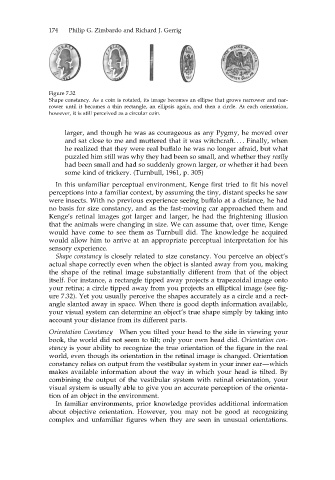
                Figure 7.32
                Shape constancy. As a coin is rotated, its image becomes an ellipse that grows narrower and nar-
                rower until it becomes a thin rectangle, an ellipsis again, and then a circle. At each orientation,
                however, it is still perceived as a circular coin.

                     larger, and though he was as courageous as any Pygmy, he moved over
                     and sat close to me and muttered that it was witchcraft.... Finally, when
                     he realized that they were real buffalo he was no longer afraid, but what
                     puzzled him still was why they had been so small, and whether they really
                     had been small and had so suddenly grown larger, or whether it had been
                     some kind of trickery. (Turnbull, 1961, p. 305)
                  In this unfamiliar perceptual environment, Kenge first tried to fit his novel
                perceptions into a familiar context, by assuming the tiny, distant specks he saw
                were insects. With no previous experience seeing buffalo at a distance, he had
                no basis for size constancy, and as the fast-moving car approached them and
                Kenge’s retinal images got larger and larger, he had the frightening illusion
                that the animals were changing in size. We can assume that, over time, Kenge
                would have come to see them as Turnbull did. The knowledge he acquired
                would allow him to arrive at an appropriate perceptual interpretation for his
                sensory experience.
                  Shape constancy is closely related to size constancy. You perceive an object’s
                actual shape correctly even when the object is slanted away from you, making
                the shape of the retinal image substantially different from that of the object
                itself. For instance, a rectangle tipped away projects a trapezoidal image onto
                your retina; a circle tipped away from you projects an elliptical image (see fig-
                ure 7.32). Yet you usually perceive the shapes accurately as a circle and a rect-
                angle slanted away in space. When there is good depth information available,
                your visual system can determine an object’s true shape simply by taking into
                account your distance from its different parts.
                Orientation Constancy  When you tilted your head to the side in viewing your
                book, the world did not seem to tilt; only your own head did. Orientation con-
                stancy is your ability to recognize the true orientation of the figure in the real
                world, even though its orientation in the retinal image is changed. Orientation
                constancy relies on output from the vestibular system in your inner ear—which
                makes available information about the way in which your head is tilted. By
                combining the output of the vestibular system with retinal orientation, your
                visual system is usually able to give you an accurate perception of the orienta-
                tion of an object in the environment.
                  In familiar environments, prior knowledge provides additional information
                about objective orientation. However, you may not be good at recognizing
                complex and unfamiliar figures when they are seen in unusual orientations.

