


Page 174 - Foundations of Cognitive Psychology : Core Readings
P. 174
178   Philip G. Zimbardo and Richard J. Gerrig


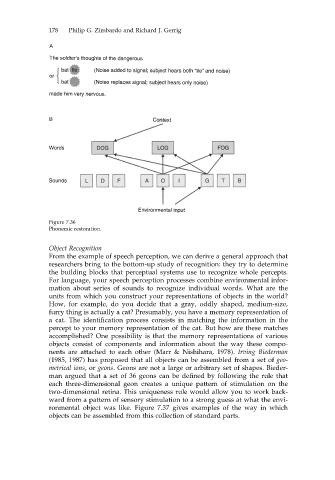
                Figure 7.36
                Phonemic restoration.


                Object Recognition
                From the example of speech perception, we can derive a general approach that
                researchers bring to the bottom-up study of recognition: they try to determine
                the building blocks that perceptual systems use to recognize whole percepts.
                For language, your speech perception processes combine environmental infor-
                mation about series of sounds to recognize individual words. What are the
                units from which you construct your representations of objects in the world?
                How, for example, do you decide that a gray, oddly shaped, medium-size,
                furry thing is actually a cat? Presumably, you have a memory representation of
                a cat. The identification process consists in matching the information in the
                percept to your memory representation of the cat. But how are these matches
                accomplished? One possibility is that the memory representations of various
                objects consist of components and information about the way these compo-
                nents are attached to each other (Marr & Nishihara, 1978). Irving Biederman
                (1985, 1987) has proposed that all objects can be assembled from a set of geo-
                metrical ions,or geons. Geons are not a large or arbitrary set of shapes. Bieder-
                manarguedthatasetof36geons canbedefinedbyfollowing therulethat
                each three-dimensional geon creates a unique pattern of stimulation on the
                two-dimensional retina. This uniqueness rule would allow you to work back-
                ward from a pattern of sensory stimulation to a strong guess at what the envi-
                ronmental object was like. Figure 7.37 gives examples of the way in which
                objects can be assembled from this collection of standard parts.

