


Page 177 - Foundations of Cognitive Psychology : Core Readings
P. 177
Perception  181


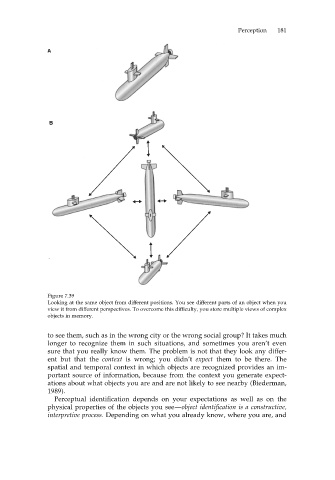
               Figure 7.39
               Looking at the same object from different positions. You see different parts of an object when you
               view it from different perspectives. To overcome this difficulty, you store multiple views of complex
               objects in memory.

               to seethem, such as in thewrong city or thewrong social group? It takesmuch
               longer to recognize them in such situations, and sometimes you aren’t even
               sure that you really know them. The problem is not that they look any differ-
               ent but that the context is wrong; you didn’t expect them to be there. The
               spatial and temporal context in which objects are recognized provides an im-
               portant source of information, because from the context you generate expect-
               ations about what objects you are and are not likely to see nearby (Biederman,
               1989).
                 Perceptual identification depends on your expectations as well as on the
               physical properties of the objects you see—object identification is a constructive,
               interpretive process. Depending on what you already know, where you are, and

