


Page 178 - Foundations of Cognitive Psychology : Core Readings
P. 178
182   Philip G. Zimbardo and Richard J. Gerrig

                what else you see around you, your identification may vary. Read the follow-
                ing words:


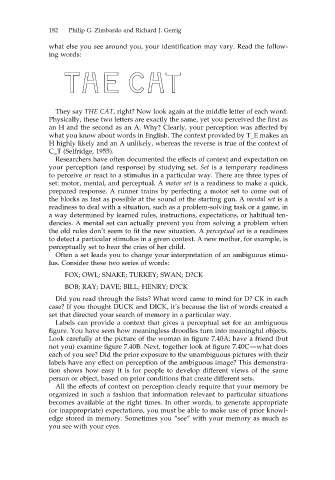
                  They say THE CAT, right? Now look again at the middle letter of each word.
                Physically, these two letters are exactly the same, yet you perceived the first as
                an H and the second as an A. Why? Clearly, your perception was affected by
                what you know about words in English. The context provided by T_E makes an
                H highly likely and an A unlikely, whereas the reverse is true of the context of
                C_T (Selfridge, 1955).
                  Researchers have often documented the effects of context and expectation on
                your perception (and response) by studying set. Set is a temporary readiness
                to perceive or react to a stimulus in a particular way. There are three types of
                set: motor, mental, and perceptual. A motor set is areadiness to make aquick,
                prepared response. A runner trains by perfecting a motor set to come out of
                the blocks as fast as possible at the sound of the starting gun. A mental set is a
                readiness to deal with a situation, such as a problem-solving task or a game, in
                a way determined by learned rules, instructions, expectations, or habitual ten-
                dencies. A mental set can actually prevent you from solving a problem when
                the old rules don’t seem to fit the new situation. A perceptual set is a readiness
                to detect a particular stimulus in a given context. A new mother, for example, is
                perceptually set to hear the cries of her child.
                  Often a set leads you to change your interpretation of an ambiguous stimu-
                lus. Consider these two series of words:
                     FOX; OWL; SNAKE; TURKEY; SWAN; D?CK
                     BOB; RAY; DAVE; BILL; HENRY; D?CK

                  Did you read through the lists? What word came to mind for D? CK in each
                case?Ifyou thoughtDUCKand DICK, it’sbecause thelist ofwords createda
                setthatdirectedyoursearchofmemoryinaparticular way.
                  Labels can provide a context that gives a perceptual set for an ambiguous
                figure. You have seen how meaningless droodles turn into meaningful objects.
                Look carefully at the picture of the woman in figure 7.40A; have a friend (but
                not you) examine figure 7.40B. Next, together look at figure 7.40C—what does
                each of you see? Did the prior exposure to the unambiguous pictures with their
                labels have any effect on perception of the ambiguous image? This demonstra-
                tion shows how easy it is for people to develop different views of the same
                person or object, based on prior conditions that create different sets.
                  All the effects of context on perception clearly require that your memory be
                organized in such a fashion that information relevant to particular situations
                becomes available at the right times. In other words, to generate appropriate
                (or inappropriate) expectations, you must be able to make use of prior knowl-
                edge stored in memory. Sometimes you ‘‘see’’ with your memory as much as
                you see with your eyes.

