


Page 175 - Foundations of Cognitive Psychology : Core Readings
P. 175
Perception  179


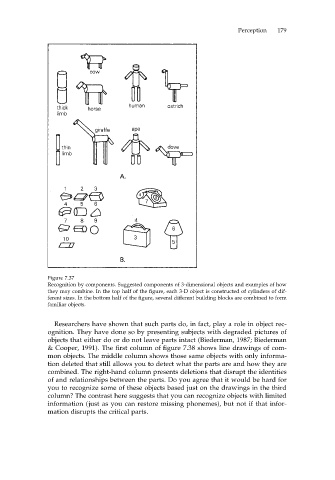
               Figure 7.37
               Recognition by components. Suggested components of 3-dimensional objects and examples of how
               they may combine. In the top half of the figure, each 3-D object is constructed of cylinders of dif-
               ferent sizes. In the bottom half of the figure, several different building blocks are combined to form
               familiar objects.

                 Researchers have shown that such parts do, in fact, play a role in object rec-
               ognition. They have done so by presenting subjects with degraded pictures of
               objects that either do or do not leave parts intact (Biederman, 1987; Biederman
               & Cooper, 1991). The first column of figure 7.38 shows line drawings of com-
               mon objects. The middle column shows those same objects with only informa-
               tion deleted that still allows you to detect what the parts are and how they are
               combined. The right-hand column presents deletions that disrupt the identities
               of and relationships between the parts. Do you agree that it would be hard for
               you to recognize some of these objects based just on the drawings in the third
               column? The contrast here suggests that you can recognize objects with limited
               information (just as you can restore missing phonemes), but not if that infor-
               mation disrupts the critical parts.

