


Page 173 - Foundations of Cognitive Psychology : Core Readings
P. 173
Perception  177


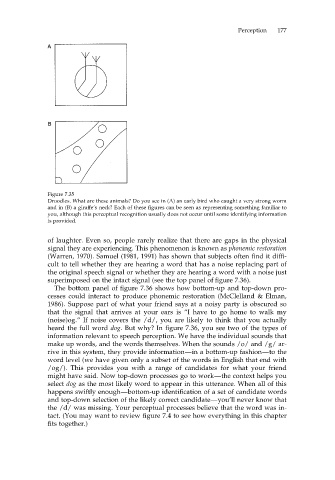
               Figure 7.35
               Droodles. What are these animals? Do you see in (A) an early bird who caught a very strong worm
               and in (B) a giraffe’s neck? Each of these figures can be seen as representing something familiar to
               you, although this perceptual recognition usually does not occur until some identifying information
               is provided.

               of laughter. Even so, people rarely realize that there are gaps in the physical
               signal they are experiencing. This phenomenon is known as phonemic restoration
               (Warren, 1970). Samuel (1981, 1991) has shown that subjects often find it diffi-
               cult to tell whether they are hearing a word that has a noise replacing part of
               the original speech signal or whether they are hearing a word with a noise just
               superimposed on the intact signal (see the top panel of figure 7.36).
                 The bottom panel of figure 7.36 shows how bottom-up and top-down pro-
               cesses could interact to produce phonemic restoration (McClelland & Elman,
               1986). Suppose part of what your friend says at a noisy party is obscured so
               that the signal that arrives at your ears is ‘‘I have to go home to walk my
               (noise)og.’’ If noise covers the /d/, you are likely to think that you actually
               heard the full word dog. But why? In figure 7.36, you see two of the types of
               information relevant to speech perception. We have the individual sounds that
               make up words, and the words themselves. When the sounds /o/ and /g/ ar-
               rive in this system, they provide information—in a bottom-up fashion—to the
               word level (we have given only a subset of the words in English that end with
               /og/). This provides you with a range of candidates for what your friend
               might have said. Now top-down processes go to work—the context helps you
               select dog as the most likely word to appear in this utterance. When all of this
               happens swiftly enough—bottom-up identification of a set of candidate words
               and top-down selection of the likely correct candidate—you’ll never know that
               the /d/ was missing. Your perceptual processes believe that the word was in-
               tact. (You may want to review figure 7.4 to see how everything in this chapter
               fits together.)

