


Page 167 - Foundations of Cognitive Psychology : Core Readings
P. 167
Perception  171


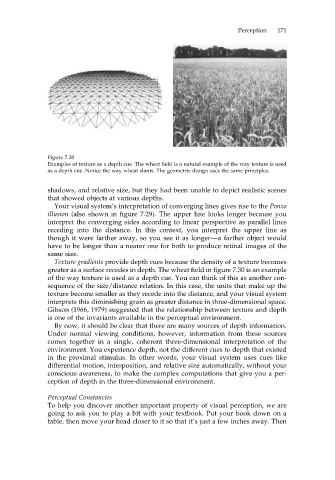
               Figure 7.30
               Examples of texture as a depth cue. The wheat field is a natural example of the way texture is used
               as a depth cue. Notice the way wheat slants. The geometric design uses the same principles.

               shadows, and relative size, but they had been unable to depict realistic scenes
               that showed objects at various depths.
                 Your visual system’s interpretation of converging lines gives rise to the Ponzo
               illusion (also shown in figure 7.29). The upper line looks longer because you
               interpret the converging sides according to linear perspective as parallel lines
               receding into the distance. In this context, you interpret the upper line as
               though it were farther away, so you see it as longer—a farther object would
               have to be longer than a nearer one for both to produce retinal images of the
               same size.
                 Texture gradients provide depth cues because the density of a texture becomes
               greater as a surface recedes in depth. The wheat field in figure 7.30 is an example
               of the way texture is used as a depth cue. You can think of this as another con-
               sequence of the size/distance relation. In this case, the units that make up the
               texture become smaller as they recede into the distance, and your visual system
               interprets this diminishing grain as greater distance in three-dimensional space.
               Gibson (1966, 1979) suggested that the relationship between texture and depth
               is one of the invariants available in the perceptual environment.
                 By now, it should be clear that there are many sources of depth information.
               Under normal viewing conditions, however, information from these sources
               comes together in a single, coherent three-dimensional interpretation of the
               environment. You experience depth, not the different cues to depth that existed
               in the proximal stimulus. In other words, your visual system uses cues like
               differential motion, interposition, and relative size automatically, without your
               conscious awareness, to make the complex computations that give you a per-
               ception of depth in the three-dimensional environment.

               Perceptual Constancies
               To help you discover another important property of visual perception, we are
               going to ask you to play a bit with your textbook. Put your book down on a
               table, then move your head closer to it so that it’s just a few inches away. Then

