


Page 164 - Foundations of Cognitive Psychology : Core Readings
P. 164
168   Philip G. Zimbardo and Richard J. Gerrig


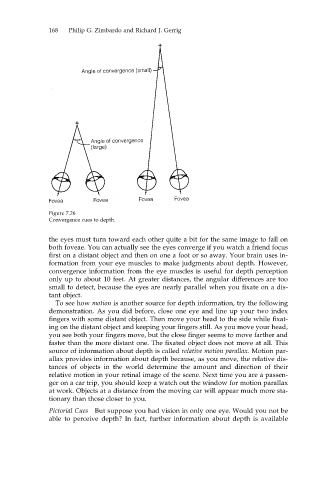
                Figure 7.26
                Convergence cues to depth.

                theeyesmustturntowardeachother quiteabitfor thesameimage to fall on
                both foveae. You can actually see the eyes converge if you watch a friend focus
                first on a distant object and then on one a foot or so away. Your brain uses in-
                formation from your eye muscles to make judgments about depth. However,
                convergence information from the eye muscles is useful for depth perception
                only up to about 10 feet. At greater distances, the angular differences are too
                small to detect, because the eyes are nearly parallel when you fixate on a dis-
                tant object.
                  To see how motion is another source for depth information, try the following
                demonstration. As you did before, close one eye and line up your two index
                fingers with some distant object. Then move your head to the side while fixat-
                ing on the distant object and keeping your fingers still. As you move your head,
                you see both your fingers move, but the close finger seems to move farther and
                faster than the more distant one. The fixated object does not move at all. This
                source of information about depth is called relative motion parallax. Motion par-
                allax provides information about depth because, as you move, the relative dis-
                tances of objects in the world determine the amount and direction of their
                relative motion in your retinal image of the scene. Next time you are a passen-
                geronacartrip, youshouldkeep awatch outthe window formotionparallax
                at work. Objects at a distance from the moving car will appear much more sta-
                tionary than those closer to you.
                Pictorial Cues  But suppose you had vision in only one eye. Would you not be
                able to perceive depth? In fact, further information about depth is available

