


Page 160 - Foundations of Cognitive Psychology : Core Readings
P. 160
164   Philip G. Zimbardo and Richard J. Gerrig


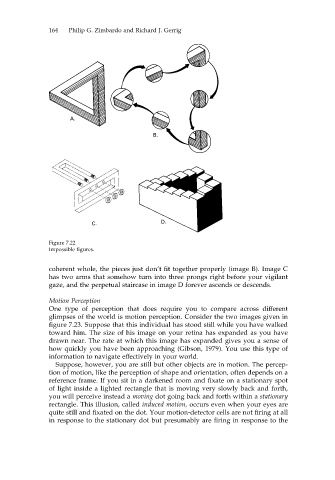
                Figure 7.22
                Impossible figures.


                coherent whole, the pieces just don’t fit together properly (image B). Image C
                has two arms that somehow turn into three prongs right before your vigilant
                gaze, and the perpetual staircase in image D forever ascends or descends.

                Motion Perception
                One type of perception that does require you to compare across different
                glimpses of the world is motion perception. Consider the two images given in
                figure 7.23. Suppose that this individual has stood still while you have walked
                toward him. The size of his image on your retina has expanded as you have
                drawn near. The rate at which this image has expanded gives you a sense of
                how quickly you have been approaching (Gibson, 1979). You use this type of
                information to navigate effectively in your world.
                  Suppose, however, you are still but other objects are in motion. The percep-
                tion of motion, like the perception of shape and orientation, often depends on a
                reference frame. If you sit in a darkened room and fixate on a stationary spot
                of light inside a lighted rectangle that is moving very slowly back and forth,
                you will perceive instead a moving dot going back and forth within a stationary
                rectangle. This illusion, called induced motion, occurs even when your eyes are
                quite still and fixated on the dot. Your motion-detector cells are not firing at all
                in response to the stationary dot but presumably are firing in response to the

