


Page 155 - Foundations of Cognitive Psychology : Core Readings
P. 155
Perception  159


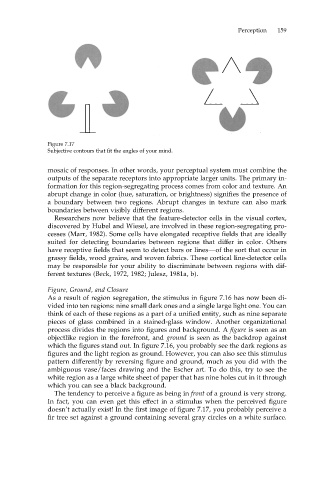
               Figure 7.17
               Subjectivecontoursthatfitthe angles of your mind.

               mosaic of responses. In other words, your perceptual system must combine the
               outputs of the separate receptors into appropriate larger units. The primary in-
               formation for this region-segregating process comes from color and texture. An
               abrupt change in color (hue, saturation, or brightness) signifies the presence of
               a boundary between two regions. Abrupt changes in texture can also mark
               boundaries between visibly different regions.
                 Researchers now believe that the feature-detector cells in the visual cortex,
               discovered by Hubel and Wiesel, are involved in these region-segregating pro-
               cesses (Marr, 1982). Some cells have elongated receptive fields that are ideally
               suited for detecting boundaries between regions that differ in color. Others
               have receptive fields that seem to detect bars or lines—of the sort that occur in
               grassy fields, wood grains, and woven fabrics. These cortical line-detector cells
               may be responsible for your ability to discriminate between regions with dif-
               ferent textures (Beck, 1972, 1982; Julesz, 1981a, b).

               Figure, Ground, and Closure
               As a result of region segregation, the stimulus in figure 7.16 has now been di-
               vided into ten regions: nine small dark ones and a single large light one. You can
               think of each of these regions as a part of a unified entity, such as nine separate
               pieces of glass combined in a stained-glass window. Another organizational
               process divides the regions into figures and background. A figure is seen as an
               objectlike region in the forefront, and ground is seen as the backdrop against
               which the figures stand out. In figure 7.16, you probably see the dark regions as
               figures and the light region as ground. However, you can also see this stimulus
               patterndifferently by reversing figureand ground,muchasyou didwiththe
               ambiguousvase/facesdrawingand theEscherart.Todothis, trytosee the
               white region as a large white sheet of paper that has nine holes cut in it through
               which you can see a black background.
                 The tendency to perceive a figure as being in front of a ground is very strong.
               In fact, you can even get this effect in a stimulus when the perceived figure
               doesn’t actually exist! In the first image of figure 7.17, you probably perceive a
               fir tree set against a ground containing several gray circles on a white surface.

