


Page 153 - Foundations of Cognitive Psychology : Core Readings
P. 153
Perception  157


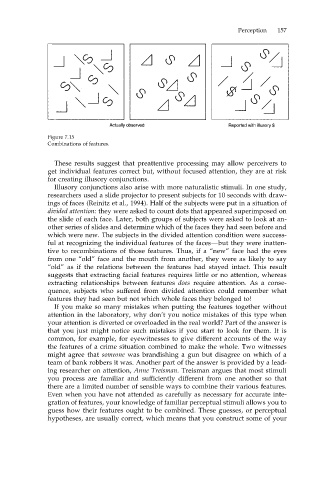
               Figure 7.15
               Combinations of features.


                 These results suggest that preattentive processing may allow perceivers to
               get individual features correct but, without focused attention, they are at risk
               for creating illusory conjunctions.
                 Illusory conjunctions also arise with more naturalistic stimuli. In one study,
               researchers used a slide projector to present subjects for 10 seconds with draw-
               ings of faces (Reinitz et al., 1994). Half of the subjects were put in a situation of
               divided attention: they were asked to count dots that appeared superimposed on
               the slide of each face. Later, both groups of subjects were asked to look at an-
               other series of slides and determine which of the faces they had seen before and
               which were new. The subjects in the divided attention condition were success-
               ful at recognizing the individual features of the faces—but they were inatten-
               tive to recombinations of those features. Thus, if a ‘‘new’’ face had the eyes
               from one ‘‘old’’ face and the mouth from another, they were as likely to say
               ‘‘old’’ as if the relations between the features had stayed intact. This result
               suggeststhatextractingfacialfeaturesrequireslittleornoattention,whereas
               extracting relationships between features does require attention. As a conse-
               quence, subjects who suffered from divided attention could remember what
               features they had seen but not which whole faces they belonged to!
                 If you make so many mistakes when putting the features together without
               attention in the laboratory, why don’t you notice mistakes of this type when
               your attention is diverted or overloaded in the real world? Part of the answer is
               that you just might notice such mistakes if you start to look for them. It is
               common, for example, for eyewitnesses to give different accounts of the way
               the features of a crime situation combined to make the whole. Two witnesses
               might agree that someone was brandishing a gun but disagree on which of a
               team of bank robbers it was. Another part of the answer is provided by a lead-
               ing researcher on attention, Anne Treisman. Treisman argues that most stimuli
               you process are familiar and sufficiently different from one another so that
               there are a limited number of sensible ways to combine their various features.
               Even when you have not attended as carefully as necessary for accurate inte-
               gration of features, your knowledge of familiar perceptual stimuli allows you to
               guess how their features ought to be combined. These guesses, or perceptual
               hypotheses, are usually correct, which means that you construct some of your

