


Page 154 - Foundations of Cognitive Psychology : Core Readings
P. 154
158   Philip G. Zimbardo and Richard J. Gerrig


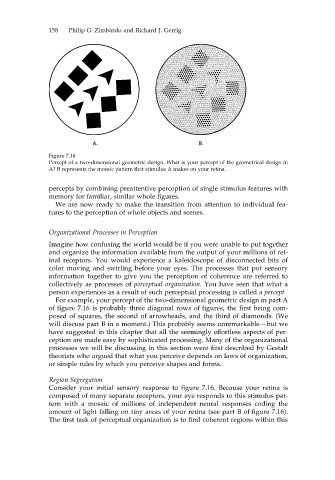
                Figure 7.16
                Percept of a two-dimensional geometric design. What is your percept of the geometrical design in
                A? B represents the mosaic pattern that stimulus A makes on your retina.


                percepts by combining preattentive perception of single stimulus features with
                memory for familiar, similar whole figures.
                  We are now ready to make the transition from attention to individual fea-
                tures to the perception of whole objects and scenes.


                Organizational Processes in Perception
                Imagine how confusing the world would be if you were unable to put together
                and organize the information available from the output of your millions of ret-
                inal receptors. You would experience a kaleidoscope of disconnected bits of
                color moving and swirling before your eyes. The processes that put sensory
                information together to give you the perception of coherence are referred to
                collectively as processes of perceptual organization. You have seen that what a
                person experiences as a result of such perceptual processing is called a percept.
                  For example, your percept of the two-dimensional geometric design in part A
                of figure 7.16 is probably three diagonal rows of figures, the first being com-
                posed of squares, the second of arrowheads, and the third of diamonds. (We
                will discuss part B in a moment.) This probably seems unremarkable—but we
                have suggested in this chapter that all the seemingly effortless aspects of per-
                ception are made easy by sophisticated processing. Many of the organizational
                processes we will be discussing in this section were first described by Gestalt
                theorists who argued that what you perceive depends on laws of organization,
                or simple rules by which you perceive shapes and forms.

                Region Segregation
                Consider your initial sensory response to figure 7.16. Because your retina is
                composed of many separate receptors, your eye responds to this stimulus pat-
                tern with a mosaic of millions of independent neural responses coding the
                amount of light falling on tiny areas of your retina (see part B of figure 7.16).
                The first task of perceptual organization is to find coherent regions within this

