


Page 150 - Foundations of Cognitive Psychology : Core Readings
P. 150
154   Philip G. Zimbardo and Richard J. Gerrig


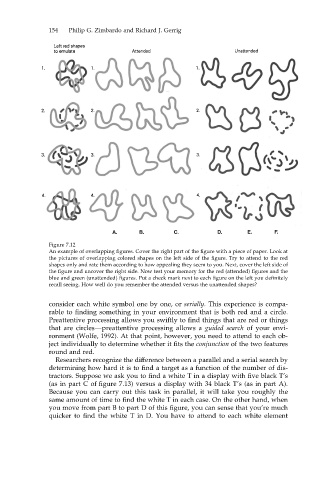
                Figure 7.12
                An example of overlapping figures. Cover the right part of the figure with a piece of paper. Look at
                the pictures of overlapping colored shapes on the left side of the figure. Try to attend to the red
                shapes only and rate them according to how appealing they seem to you. Next, cover the left side of
                the figure and uncover the right side. Now test your memory for the red (attended) figures and the
                blue and green (unattended) figures. Put a check mark next to each figure on the left you definitely
                recall seeing. How well do you remember the attended versus the unattended shapes?

                consider each white symbol one by one, or serially. This experience is compa-
                rable to finding something in your environment that is both red and a circle.
                Preattentive processing allows you swiftly to find things that are red or things
                that are circles—preattentive processing allows a guided search of your envi-
                ronment (Wolfe, 1992). At that point, however, you need to attend to each ob-
                ject individually to determine whether it fits the conjunction of the two features
                round and red.
                  Researchers recognize the difference between a parallel and a serial search by
                determining how hard it is to find a target as a function of the number of dis-
                tractors. Suppose we ask you to find a white T in a display with five black T’s
                (as in part C of figure 7.13) versus a display with 34 black T’s (as in part A).
                Because you can carry out this task in parallel, it will take you roughly the
                same amount of time to find the white T in each case. On the other hand, when
                you move from part B to part D of this figure, you can sense that you’re much
                quicker to find the white T in D. You have to attend to each white element

