


Page 152 - Foundations of Cognitive Psychology : Core Readings
P. 152
156   Philip G. Zimbardo and Richard J. Gerrig


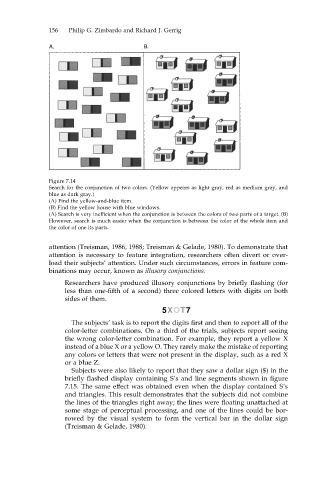
                Figure 7.14
                Search for the conjunction of two colors. (Yellow appears as light gray, red as medium gray, and
                blue as dark gray.)
                (A) Find the yellow-and-blue item.
                (B) Find the yellow house with blue windows.
                (A) Search is very inefficient when the conjunction is between the colors of two parts of a target. (B)
                However, search is much easier when the conjunction is between the color of the whole item and
                the color of one its parts.


                attention (Treisman, 1986, 1988; Treisman & Gelade, 1980). To demonstrate that
                attention is necessary to feature integration, researchers often divert or over-
                load their subjects’ attention. Under such circumstances, errors in feature com-
                binations may occur, known as illusory conjunctions.
                     Researchers have produced illusory conjunctions by briefly flashing (for
                     less than one-fifth of a second) three colored letters with digits on both
                     sides of them.
                                                  5XOT7
                      The subjects’ task is to report the digits first and then to report all of the
                     color-letter combinations. On a third of the trials, subjects report seeing
                     the wrong color-letter combination. For example, they report a yellow X
                     instead of a blue X or a yellow O. They rarely make the mistake of reporting
                     any colors or letters that were not present in the display, such as a red X
                     or a blue Z.
                      Subjects were also likely to report that they saw a dollar sign ($) in the
                     briefly flashed display containing S’s and line segments shown in figure
                     7.15. The same effect was obtained even when the display contained S’s
                     and triangles. This result demonstrates that the subjects did not combine
                     the lines of the triangles right away; the lines were floating unattached at
                     some stage of perceptual processing, and one of the lines could be bor-
                     rowed by the visual system to form the vertical bar in the dollar sign
                     (Treisman & Gelade, 1980).

