


Page 141 - Foundations of Cognitive Psychology : Core Readings
P. 141
Perception  145


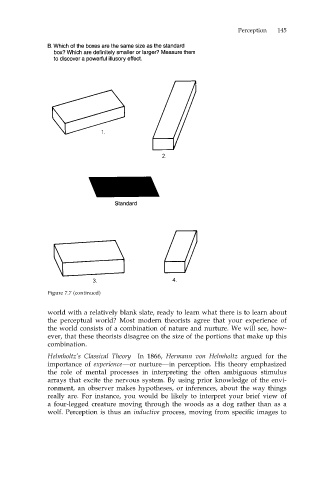
               Figure 7.7 (continued)


               world with a relatively blank slate, ready to learn what there is to learn about
               the perceptual world? Most modern theorists agree that your experience of
               the world consists of a combination of nature and nurture. We will see, how-
               ever, that these theorists disagree on the size of the portions that make up this
               combination.
               Helmholtz’s Classical Theory  In 1866, Hermann von Helmholtz argued for the
               importance of experience—or nurture—in perception. His theory emphasized
               the role of mental processes in interpreting the often ambiguous stimulus
               arrays that excite the nervous system. By using prior knowledge of the envi-
               ronment, an observer makes hypotheses, or inferences, about the way things
               really are. For instance, you would be likely to interpret your brief view of
               a four-legged creature moving through the woods as a dog rather than as a
               wolf. Perception is thus an inductive process, moving from specific images to

