


Page 250 - Foundations of Cognitive Psychology : Core Readings
P. 250
256   Eleanor Rosch

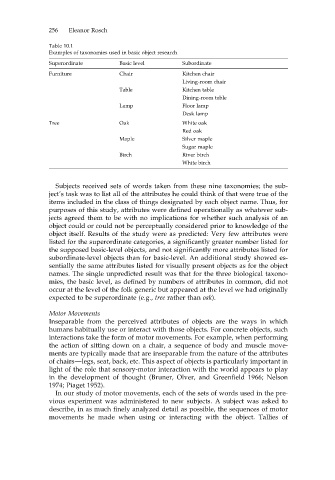
                Table 10.1
                Examples of taxonomies used in basic object research
                Superordinate        Basic level        Subordinate
                Furniture            Chair              Kitchen chair
                                                        Living-room chair
                                     Table              Kitchen table
                                                        Dining-room table
                                     Lamp               Floor lamp
                                                        Desk lamp
                Tree                 Oak                White oak
                                                        Red oak
                                     Maple              Silver maple
                                                        Sugar maple
                                     Birch              River birch
                                                        White birch


                  Subjects received sets of words taken from these nine taxonomies; the sub-
                ject’s task was to list all of the attributes he could think of that were true of the
                items included in the class of things designated by each object name. Thus, for
                purposes of this study, attributes were defined operationally as whatever sub-
                jects agreed them to be with no implications for whether such analysis of an
                object could or could not be perceptually considered prior to knowledge of the
                object itself. Results of the study were as predicted: Very few attributes were
                listed for the superordinate categories, a significantly greater number listed for
                the supposed basic-level objects, and not significantly more attributes listed for
                subordinate-level objects than for basic-level. An additional study showed es-
                sentially the same attributes listed for visually present objects as for the object
                names. The single unpredicted result was that for the three biological taxono-
                mies, the basic level, as defined by numbers of attributes in common, did not
                occur at the level of the folk generic but appeared at the level we had originally
                expected to be superordinate (e.g., tree rather than oak).

                Motor Movements
                Inseparable from the perceived attributes of objects are the ways in which
                humans habitually use or interact with those objects. For concrete objects, such
                interactions take the form of motor movements. For example, when performing
                the action of sitting down on a chair, a sequence of body and muscle move-
                ments are typically made that are inseparable from the nature of the attributes
                of chairs—legs, seat, back, etc. This aspect of objects is particularly important in
                light of the role that sensory-motor interaction with the world appears to play
                in the development of thought (Bruner, Olver, and Greenfield 1966; Nelson
                1974; Piaget 1952).
                  In our study of motor movements, each of the sets of words used in the pre-
                vious experiment was administered to new subjects. A subject was asked to
                describe, in as much finely analyzed detail as possible, the sequences of motor
                movements he made when using or interacting with the object. Tallies of

