


Page 162 - From Bombay to Bollywoord The Making of a Global Media Industri
P. 162
Diasporic Entrepreneurs and Digital Media  >>  149


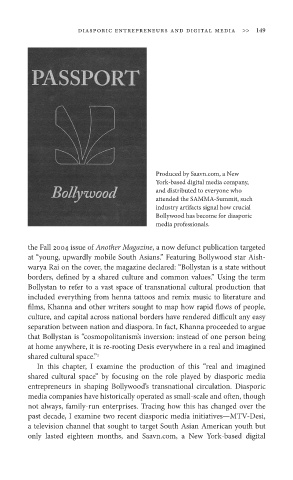
                                          Produced by Saavn.com, a New
                                          York-based digital media company,
                                          and distributed to everyone who
                                          attended the SAMMA-Summit, such
                                          industry artifacts signal how crucial
                                          Bollywood has become for diasporic
                                          media professionals.


        the Fall 2004 issue of Another Magazine, a now defunct publication targeted
        at “young, upwardly mobile South Asians.” Featuring Bollywood star Aish-
        warya Rai on the cover, the magazine declared: “Bollystan is a state without
        borders, defined by a shared culture and common values.” Using the term
        Bollystan to refer to a vast space of transnational cultural production that
        included everything from henna tattoos and remix music to literature and
        films, Khanna and other writers sought to map how rapid flows of people,
        culture, and capital across national borders have rendered difficult any easy
        separation between nation and diaspora. In fact, Khanna proceeded to argue
        that Bollystan is “cosmopolitanism’s inversion: instead of one person being
        at home anywhere, it is re-rooting Desis everywhere in a real and imagined
        shared cultural space.” 2
           In this chapter, I examine the production of this “real and imagined
        shared cultural space” by focusing on the role played by diasporic media
        entrepreneurs in shaping Bollywood’s transnational circulation. Diasporic
        media companies have historically operated as small-scale and often, though
        not always, family-run enterprises. Tracing how this has changed over the
        past decade, I examine two recent diasporic media initiatives—MTV-Desi,
        a television channel that sought to target South Asian American youth but
        only lasted eighteen months, and Saavn.com, a New York-based digital

