


Page 448 - Fundamentals of Enhanced Oil and Gas Recovery
P. 448
436                                                                            Afshin Tatar


                   with the cell attachment. Even in case of release of dying of cells, the biopolymers
                   will be left behind [792].
                   Fractured carbonate reservoir contains most of the world’s oil [793]. In this type of
                reservoirs, the matrix blocks are mixed to oil-wet. This characteristic leads to difficult
                water absorption onto the matrix blocks, which in turn diminishes the sweep effi-
                ciency. In fact, the oil trapped in this region will be unaffected by the floodwater
                [15]. It is proved that the oil recovery can be improved by turning the matrix surface
                to a more water-wet condition [16]. As it was mentioned before, this can be done by
                introducing surfactants, enzymes, or development of a biofilm on the reservoir rock
                surface by microorganisms. Wettability alteration plays a crucial role in oil and surfac-
                tant adsorption in carbonates and clays [10]. In spite of carbonates, wettability of the
                mineral surfaces plays a secondary role in oil displacement in sandstone formations.
                Thus, wettability reversal by microbial activity will not provide a promising mecha-
                nism for enhancing oil recovery in sandstone formations [66]. However, when the
                hydrocarbon degrading microorganisms coat the oil droplets with a biofilm, the role
                of wettability may become trivial [771,794]. Karimi et al. [715] through their experi-
                ments concluded that the effect of biofilm formation was much more significant com-
                pared with many other microbial products including biosurfactants in enhancement of
                wettability. It is reported that brine composition affects the wettability changes
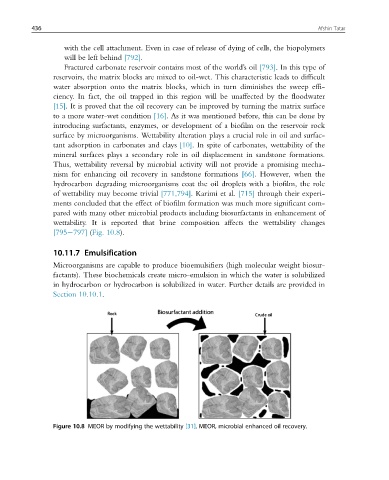
                [795 797] (Fig. 10.8).

                10.11.7 Emulsification
                Microorganisms are capable to produce bioemulsifiers (high molecular weight biosur-
                factants). These biochemicals create micro-emulsion in which the water is solubilized
                in hydrocarbon or hydrocarbon is solubilized in water. Further details are provided in
                Section 10.10.1.


                Figure 10.8 MEOR by modifying the wettability [31]. MEOR, microbial enhanced oil recovery.

