


Page 450 - Fundamentals of Enhanced Oil and Gas Recovery
P. 450
438                                                                            Afshin Tatar


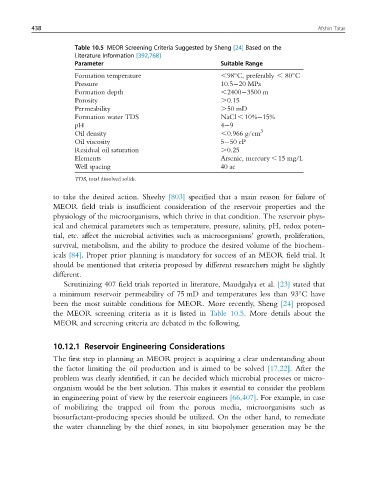
                      Table 10.5 MEOR Screening Criteria Suggested by Sheng [24] Based on the
                      Literature Information [392,768]
                      Parameter                               Suitable Range

                      Formation temperature                   ,98 C, preferably , 80 C


                      Pressure                                10.5 20 MPa
                      Formation depth                         ,2400 3500 m
                      Porosity                                .0.15
                      Permeability                            .50 mD
                      Formation water TDS                     NaCl , 10% 15%
                      pH                                      4 9
                      Oil density                             ,0.966 g/cm 3
                      Oil viscosity                           5 50 cP
                      Residual oil saturation                 .0.25
                      Elements                                Arsenic, mercury , 15 mg/L
                      Well spacing                            40 ac

                      TDS, total dissolved solids.

                to take the desired action. Sheehy [803] specified that a main reason for failure of
                MEOR field trials is insufficient consideration of the reservoir properties and the
                physiology of the microorganisms, which thrive in that condition. The reservoir phys-
                ical and chemical parameters such as temperature, pressure, salinity, pH, redox poten-
                tial, etc. affect the microbial activities such as microorganisms’ growth, proliferation,
                survival, metabolism, and the ability to produce the desired volume of the biochem-
                icals [84]. Proper prior planning is mandatory for success of an MEOR field trial. It
                should be mentioned that criteria proposed by different researchers might be slightly
                different.
                   Scrutinizing 407 field trials reported in literature, Maudgalya et al. [23] stated that

                a minimum reservoir permeability of 75 mD and temperatures less than 93 Chave
                been the most suitable conditions for MEOR. More recently, Sheng [24] proposed
                the MEOR screening criteria as it is listed in Table 10.5. More details about the
                MEOR and screening criteria are debated in the following.


                10.12.1 Reservoir Engineering Considerations

                The first step in planning an MEOR project is acquiring a clear understanding about
                the factor limiting the oil production and is aimed to be solved [17,22]. After the
                problem was clearly identified, it can be decided which microbial processes or micro-
                organism would be the best solution. This makes it essential to consider the problem
                in engineering point of view by the reservoir engineers [66,407]. For example, in case
                of mobilizing the trapped oil from the porous media, microorganisms such as
                biosurfactant-producing species should be utilized. On the other hand, to remediate
                the water channeling by the thief zones, in situ biopolymer generation may be the

