


Page 451 - Fundamentals of Enhanced Oil and Gas Recovery
P. 451
Microbial Enhanced Oil Recovery: Microbiology and Fundamentals                      439


                   Table 10.6 Production Problems and Suitable MEOR Processes Modified After Bryant and Rhonda
                   [392] and Volk and Hendry [22]
                   Production Problems  MEOR Process    Helpful Microorganisms

                   Formation damage, low Well stimulation  Generally surfactant, gas, acid, and alcohol
                     oil relative                         producers
                     permeability
                   Trapped oil due to   Waterflooding   Generally surfactant, gas, acid, and alcohol
                     capillary forces                     producers
                   Poor seep efficiency,  Permeability  Microorganisms that produce polymer and/or
                     channeling           modification    copious amounts of biomass
                   Paraffin problems,   Wellbore cleanup  Microorganisms that produce emulsifiers,
                     scaling                              surfactants, and acids. Microorganisms that
                                                          degrade hydrocarbons
                   Unfavorable mobility  Polymer flooding  Microorganisms that produce polymer
                     ratio low sweep
                     efficiency
                   Water or gas coning  Mitigation of   Microorganisms that produce polymer and/or
                                          coning and/or   copious amounts of biomass
                                          copious


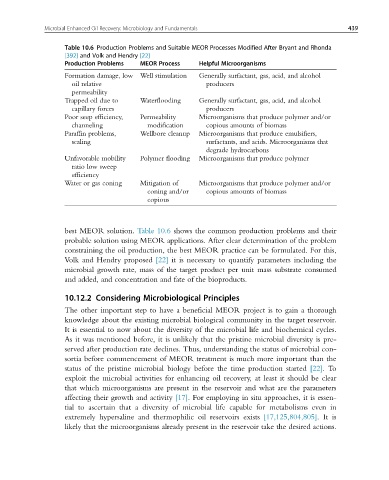
                   best MEOR solution. Table 10.6 shows the common production problems and their
                   probable solution using MEOR applications. After clear determination of the problem
                   constraining the oil production, the best MEOR practice can be formulated. For this,
                   Volk and Hendry proposed [22] it is necessary to quantify parameters including the
                   microbial growth rate, mass of the target product per unit mass substrate consumed
                   and added, and concentration and fate of the bioproducts.

                   10.12.2 Considering Microbiological Principles
                   The other important step to have a beneficial MEOR project is to gain a thorough
                   knowledge about the existing microbial biological community in the target reservoir.
                   It is essential to now about the diversity of the microbial life and biochemical cycles.
                   As it was mentioned before, it is unlikely that the pristine microbial diversity is pre-
                   served after production rate declines. Thus, understanding the status of microbial con-
                   sortia before commencement of MEOR treatment is much more important than the
                   status of the pristine microbial biology before the time production started [22].To
                   exploit the microbial activities for enhancing oil recovery, at least it should be clear
                   that which microorganisms are present in the reservoir and what are the parameters
                   affecting their growth and activity [17]. For employing in situ approaches, it is essen-
                   tial to ascertain that a diversity of microbial life capable for metabolisms even in
                   extremely hypersaline and thermophilic oil reservoirs exists [17,125,804,805].Itis
                   likely that the microorganisms already present in the reservoir take the desired actions.

