


Page 461 - Fundamentals of Enhanced Oil and Gas Recovery
P. 461
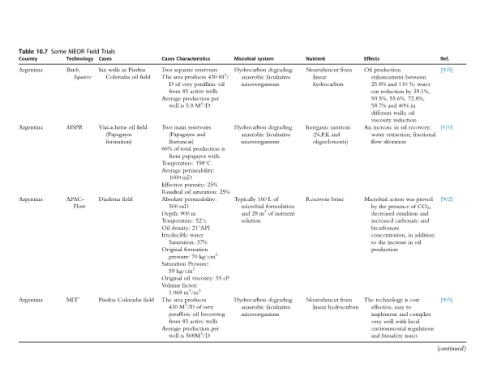
(continued)


                  Ref.  [905]        [410]               [902]                       [905]


                       between  water  %;  110  39.1%,  by  72.8%,  in  40%  oil  reduction  recovery;  oil  fractional  proved  was  CO 2 ,  of  and emulsion  and carbonate  addition  in  oil  in  cost  is  to  complies  and  local  regulations  issues


                     production  enhancement  and  reduction  55.6%,  and  wells;  different  viscosity  in  increase  retraction;  alteration  action  presence  the  decreased  increased  bicarbonate  concentration,  increase  the  production  technology  easy  effective,  implement  with  well  environmental  biosafety


                  Effects  Oil  25.8%  cut  59.5%,  58.7%  An  water  flow  Microbial  by  to  The  very  and


                     from            nutrient  and  oligoelements)  brine            from  hydrocarbon


                  Nutrient  Nourishment  linear  hydrocarbon  Inorganic  (N,P ,K  Reservoir  Nourishment  linear


                     degrading  facultative  degrading  facultative  of  formulation  nutrient  degrading  facultative

                  system  microorganisms  microorganisms  L  160  of  m 3                microorganisms

                  Microbial  Hydrocarbon  anaerobic  Hydrocarbon  anaerobic  Typically  microbial  28  and  solution  Hydrocarbon  anaerobic


                       M 3 /  430  oil  wells  per  is  with:  25%  25%  kg/cm 2  cP  55  becoming  wells  per

                  Characteristics  reservoirs  separate  produces  paraffinic  very  active  85  production  M 3 /D  5.8  is  reservoirs  main  and (Papagayos  Barrancas)  production  total  papagayos  198   C  permeability:  mD  porosity:  saturation:  oil  permeability:  mD  m  900  52   c  21   API density:  water  37% Saturation:  formation  70  Pressure:  kg/cm 2  viscosity:  oil  factor:  m 3 /m 3  produces  very  of  M 3


                  Cases  Two  area  The  of  D  from  Average  well  Two  of  60%  from  Temperature:  Average  1000  Effective  Residual  Absolute  500  Depth:  Temperature:  Oil  Irreducible  Original  pressure:  Saturation  59  Original  Volume  1.068  area  The  430  paraffinic  from  Average  well


                     Piedras  field  oil  field  oil                                 field

                     in  Coloradas     (Papagayos  formation)  field                 Coloradas
                Trials  Cases  wells  Six  Vizcacheras   Diadema                     Piedras

                Field

                MEOR  Technology  Batch,  Squeeze  MSPR  APAC-  Flow                 MIT a

                Some

                10.7
                Table  Country  Argentina  Argentina     Argentina                   Argentina

