


Page 290 - Fundamentals of Geomorphology
P. 290
GLACIAL AND GLACIOFLUVIAL LANDSCAPES 273


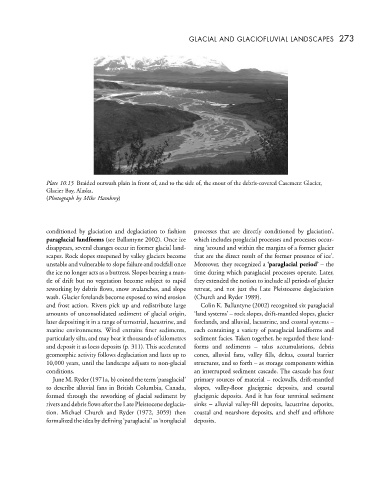
              Plate 10.15 Braided outwash plain in front of, and to the side of, the snout of the debris-covered Casement Glacier,
              Glacier Bay, Alaska.
              (Photograph by Mike Hambrey)


              conditioned by glaciation and deglaciation to fashion  processes that are directly conditioned by glaciation’,
              paraglacial landforms (see Ballantyne 2002). Once ice  which includes proglacial processes and processes occur-
              disappears, several changes occur in former glacial land-  ring ‘around and within the margins of a former glacier
              scapes. Rock slopes steepened by valley glaciers become  that are the direct result of the former presence of ice’.
              unstable and vulnerable to slope failure and rockfall once  Moreover, they recognized a ‘paraglacial period’ – the
              the ice no longer acts as a buttress. Slopes bearing a man-  time during which paraglacial processes operate. Later,
              tle of drift but no vegetation become subject to rapid  they extended the notion to include all periods of glacier
              reworking by debris flows, snow avalanches, and slope  retreat, and not just the Late Pleistocene deglaciation
              wash. Glacier forelands become exposed to wind erosion  (Church and Ryder 1989).
              and frost action. Rivers pick up and redistribute large  Colin K. Ballantyne (2002) recognized six paraglacial
              amounts of unconsolidated sediment of glacial origin,  ‘land systems’ – rock slopes, drift-mantled slopes, glacier
              later depositing it in a range of terrestrial, lacustrine, and  forelands, and alluvial, lacustrine, and coastal systems –
              marine environments. Wind entrains finer sediments,  each containing a variety of paraglacial landforms and
              particularly silts, and may bear it thousands of kilometres  sediment facies. Taken together, he regarded these land-
              and deposit it as loess deposits (p. 311). This accelerated  forms and sediments – talus accumulations, debris
              geomorphic activity follows deglaciation and lasts up to  cones, alluvial fans, valley fills, deltas, coastal barrier
              10,000 years, until the landscape adjusts to non-glacial  structures, and so forth – as storage components within
              conditions.                               an interrupted sediment cascade. The cascade has four
                June M. Ryder (1971a, b) coined the term ‘paraglacial’  primary sources of material – rockwalls, drift-mantled
              to describe alluvial fans in British Columbia, Canada,  slopes, valley-floor glacigenic deposits, and coastal
              formed through the reworking of glacial sediment by  glacigenic deposits. And it has four terminal sediment
              rivers and debris flows after the Late Pleistocene deglacia-  sinks – alluvial valley-fill deposits, lacustrine deposits,
              tion. Michael Church and Ryder (1972, 3059) then  coastal and nearshore deposits, and shelf and offshore
              formalized the idea by defining ‘paraglacial’ as ‘nonglacial  deposits.

