


Page 287 - Fundamentals of Ocean Renewable Energy Generating Electricity From The Sea
P. 287
274 Fundamentals of Ocean Renewable Energy


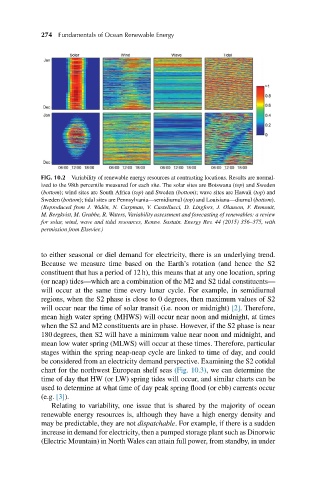
            FIG. 10.2  Variability of renewable energy resources at contrasting locations. Results are normal-
            ized to the 98th percentile measured for each site. The solar sites are Botswana (top) and Sweden
            (bottom); wind sites are South Africa (top) and Sweden (bottom); wave sites are Hawaii (top)and
            Sweden (bottom); tidal sites are Pennsylvania—semidiurnal (top) and Louisiana—diurnal (bottom).
            (Reproduced from J. Widén, N. Carpman, V. Castellucci, D. Lingfors, J. Olauson, F. Remouit,
            M. Bergkvist, M. Grabbe, R. Waters, Variability assessment and forecasting of renewables: a review
            for solar, wind, wave and tidal resources, Renew. Sustain. Energy Rev. 44 (2015) 356–375, with
            permission from Elsevier.)


            to either seasonal or diel demand for electricity, there is an underlying trend.
            Because we measure time based on the Earth’s rotation (and hence the S2
            constituent that has a period of 12 h), this means that at any one location, spring
            (or neap) tides—which are a combination of the M2 and S2 tidal constituents—
            will occur at the same time every lunar cycle. For example, in semidiurnal
            regions, when the S2 phase is close to 0 degrees, then maximum values of S2
            will occur near the time of solar transit (i.e. noon or midnight) [2]. Therefore,
            mean high water spring (MHWS) will occur near noon and midnight, at times
            when the S2 and M2 constituents are in phase. However, if the S2 phase is near
            180 degrees, then S2 will have a minimum value near noon and midnight, and
            mean low water spring (MLWS) will occur at these times. Therefore, particular
            stages within the spring neap-neap cycle are linked to time of day, and could
            be considered from an electricity demand perspective. Examining the S2 cotidal
            chart for the northwest European shelf seas (Fig. 10.3), we can determine the
            time of day that HW (or LW) spring tides will occur, and similar charts can be
            used to determine at what time of day peak spring flood (or ebb) currents occur
            (e.g. [3]).
               Relating to variability, one issue that is shared by the majority of ocean
            renewable energy resources is, although they have a high energy density and
            may be predictable, they are not dispatchable. For example, if there is a sudden
            increase in demand for electricity, then a pumped storage plant such as Dinorwic
            (Electric Mountain) in North Wales can attain full power, from standby, in under

