


Page 310 - Fundamentals of Ocean Renewable Energy Generating Electricity From The Sea
P. 310
Other Aspects of Ocean Renewable Energy Chapter | 10 295


             10.4.1 Impact of TEC Arrays on Sediment Dynamics
             Neill et al. [35] first introduced the possibility of nonlocalized, long timescale,
             changes in morphodynamics as a result of tidal array operation. Prior to
             this research, it had been assumed that either (a) highly energetic tidal sites
             were devoid of mobile sediment or (b) any impacts would be localized, i.e.
             scouring of sea bed sediments around the base of tidal energy devices would
             be the main issue. However, even in highly energetic environments such as the
             Pentland Firth (Scotland), the predominant bedrock will be interspersed with
             regions of sand (e.g. [52]). Such pockets of mobile sediment are important
             habitats for fisheries, and important repositories of sediment that exchange
             material with neighbouring beaches over a range of timescales [53]. In addition,
             larger offshore sand banks, such as headland sand banks generated by eddies
             associated with strong tidal flow past headlands [54], have a significant and
             important influence on the flow field [55]. Therefore, any changes in the
             morphodynamics of offshore sand banks due to tidal energy extraction will
             likely have a significant impact on the tidal energy resource.

             Tidal Asymmetry
             Since astronomical tides are generated by the combined gravitational forces of
             the Sun and the Moon, the frequencies of tidal constituents in the deep oceans
             directly relate to lunar or solar days, and can be expressed in terms of diurnal
             and semidiurnal components. The propagation of (barotropic) tides in the
             deep ocean is primarily governed by linear processes, where their interactions
             generate subharmonic tides [56]. For instance, the combination of the principal
             semidiurnal lunar (M 2 ) and solar (S 2 ) tidal constituents describes the spring
             neap cycle (Section 3.9).
                Over continental shelves, and particularly in shallow coastal waters, other
             nonlinear forces and processes such as friction, advection (due to advective in-
             ertia forces), and diffusion (due to turbulence) become increasingly responsible
             for the dynamics of the tides. As a result, the tidal signal is more complex in
             such regions, and can no longer be represented by simple linear superposition
             of semidiurnal and diurnal components. Using the concept of Fourier series,
             by combining higher-frequency tidal components or superharmonic tides, any
             nonlinear tidal signal can be reconstructed. Unlike astronomical tides, super-
             harmonic tidal components are generated by localized shallow water forces.
             Accordingly, the nonlinear interaction of an astronomical tidal component with
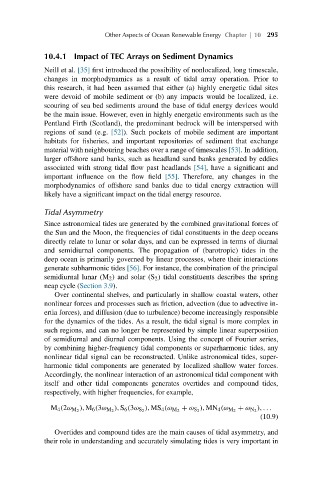
             itself and other tidal components generates overtides and compound tides,
             respectively, with higher frequencies, for example,
                                                                       ), ...
               M 4 (2ω M 2  ),M 6 (3ω M 2  ),S 6 (3ω S 2  ),MS 4 (ω M 2  + ω S 2  ),MN 4 (ω M 2  + ω N 2
                                                                       (10.9)
                Overtides and compound tides are the main causes of tidal asymmetry, and
             their role in understanding and accurately simulating tides is very important in

