


Page 307 - Fundamentals of Ocean Renewable Energy Generating Electricity From The Sea
P. 307
292 Fundamentals of Ocean Renewable Energy


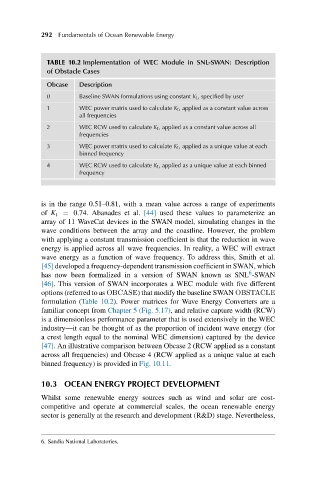
              TABLE 10.2 Implementation of WEC Module in SNL-SWAN: Description
              of Obstacle Cases
              Obcase  Description
              0       Baseline SWAN formulations using constant K t , specified by user
              1       WEC power matrix used to calculate K t , applied as a constant value across
                      all frequencies
              2       WEC RCW used to calculate K t , applied as a constant value across all
                      frequencies
              3       WEC power matrix used to calculate K t , applied as a unique value at each
                      binned frequency
              4       WEC RCW used to calculate K t , applied as a unique value at each binned
                      frequency


            is in the range 0.51–0.81, with a mean value across a range of experiments
            of K t = 0.74. Abanades et al. [44] used these values to parameterize an
            array of 11 WaveCat devices in the SWAN model, simulating changes in the
            wave conditions between the array and the coastline. However, the problem
            with applying a constant transmission coefficient is that the reduction in wave
            energy is applied across all wave frequencies. In reality, a WEC will extract
            wave energy as a function of wave frequency. To address this, Smith et al.
            [45] developed a frequency-dependent transmission coefficient in SWAN, which
                                                                    6
            has now been formalized in a version of SWAN known as SNL -SWAN
            [46]. This version of SWAN incorporates a WEC module with five different
            options (referred to as OBCASE) that modify the baseline SWAN OBSTACLE
            formulation (Table 10.2). Power matrices for Wave Energy Converters are a
            familiar concept from Chapter 5 (Fig. 5.17), and relative capture width (RCW)
            is a dimensionless performance parameter that is used extensively in the WEC
            industry—it can be thought of as the proportion of incident wave energy (for
            a crest length equal to the nominal WEC dimension) captured by the device
            [47]. An illustrative comparison between Obcase 2 (RCW applied as a constant
            across all frequencies) and Obcase 4 (RCW applied as a unique value at each
            binned frequency) is provided in Fig. 10.11.

            10.3 OCEAN ENERGY PROJECT DEVELOPMENT
            Whilst some renewable energy sources such as wind and solar are cost-
            competitive and operate at commercial scales, the ocean renewable energy
            sector is generally at the research and development (R&D) stage. Nevertheless,


            6. Sandia National Laboratories.

