


Page 303 - Fundamentals of Ocean Renewable Energy Generating Electricity From The Sea
P. 303
288 Fundamentals of Ocean Renewable Energy


            based on Eq. (10.5). In particular, opposing currents can increase wave height
            and wave steepness. This can lead to wave breaking. Referring to Eq. (10.4), the
            wave group velocity will be reduced by opposing currents. If tidal currents are
            strong enough, the group velocity approaches zero, which means that waves can
            be completely blocked by currents.
               The discussion above was based on a simplified method to help understand
            the concepts. In real applications, several ocean models offer coupled wave and
            tide modelling capability. These models can be used to simulate the interactions
            of waves and tides. For instance, SWAN has been coupled with both ADCIRC
            and ROMS models (introduced in Chapter 8). SWAN can include the effect of
            tidal currents on wave power by importing the tidal current and elevation fields
            from a tidal model (e.g. ADCIRC or ROMS).

            Effect of Waves on the Tidal Energy Resource
            Energetic waves can alter tidal currents and tidal elevations. For instance, waves
            add additional momentum/force to the tidal flow (i.e. wave radiation stresses).
            Further, the interaction of wave orbital velocities and the bottom boundary
            layer (of currents) leads to an increase in the roughness felt by currents.
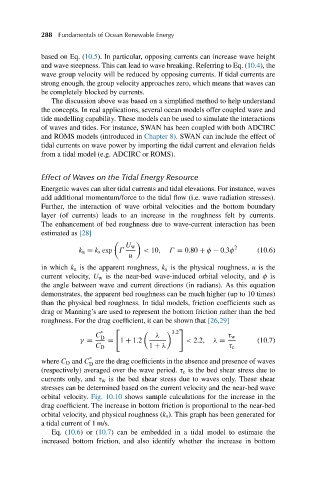
            The enhancement of bed roughness due to wave-current interaction has been
            estimated as [28]

                                   U w                          2
                      k a = k s exp Γ   < 10,  Γ = 0.80 + φ − 0.3φ     (10.6)
                                    u
            in which k a is the apparent roughness, k s is the physical roughness, u is the
            current velocity, U w is the near-bed wave-induced orbital velocity, and φ is
            the angle between wave and current directions (in radians). As this equation
            demonstrates, the apparent bed roughness can be much higher (up to 10 times)
            than the physical bed roughness. In tidal models, friction coefficients such as
            drag or Manning’s are used to represent the bottom friction rather than the bed
            roughness. For the drag coefficient, it can be shown that [26,29]
                                               3.2
                           C *             λ                   τ w
                       γ =  D  = 1 + 1.2           < 2.2,  λ =         (10.7)
                           C D           1 + λ                 τ c
                         *
            where C D and C are the drag coefficients in the absence and presence of waves
                         D
            (respectively) averaged over the wave period. τ c is the bed shear stress due to
            currents only, and τ w is the bed shear stress due to waves only. These shear
            stresses can be determined based on the current velocity and the near-bed wave
            orbital velocity. Fig. 10.10 shows sample calculations for the increase in the
            drag coefficient. The increase in bottom friction is proportional to the near-bed
            orbital velocity, and physical roughness (k s ). This graph has been generated for
            a tidal current of 1 m/s.
               Eq. (10.6) or (10.7) can be embedded in a tidal model to estimate the
            increased bottom friction, and also identify whether the increase in bottom

