


Page 301 - Fundamentals of Ocean Renewable Energy Generating Electricity From The Sea
P. 301
286 Fundamentals of Ocean Renewable Energy


            summary of the physical mechanisms of wave-tide interaction, and tools that
            can be used to investigate them. More details can be found in other resources
            (e.g. [24–26]).
               In general, tides are long waves with periods in the range of hours and
            days, whereas wind-generated waves are short waves with periods in the order
            of seconds; therefore, wave-tide interaction can be regarded as the interaction
            between long and short waves.


            Effect of Tidal Currents on Wave Energy
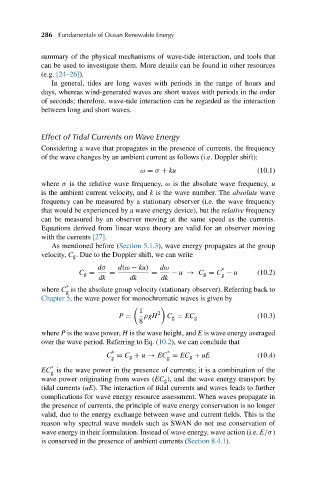
            Considering a wave that propagates in the presence of currents, the frequency
            of the wave changes by an ambient current as follows (i.e. Doppler shift):
                                       ω = σ + ku                      (10.1)
            where σ is the relative wave frequency, ω is the absolute wave frequency, u
            is the ambient current velocity, and k is the wave number. The absolute wave
            frequency can be measured by a stationary observer (i.e. the wave frequency
            that would be experienced by a wave energy device), but the relative frequency
            can be measured by an observer moving at the same speed as the currents.
            Equations derived from linear wave theory are valid for an observer moving
            with the currents [27].
               As mentioned before (Section 5.1.3), wave energy propagates at the group
            velocity, C g . Due to the Doppler shift, we can write
                           dσ    d(ω − ku)  dω               *
                      C g =    =          =    − u → C g = C − u       (10.2)
                                                             g
                            dk      dk       dk
                   *
            where C is the absolute group velocity (stationary observer). Referring back to
                   g
            Chapter 5, the wave power for monochromatic waves is given by
                                       1    2

                                 P =    ρgH   C g = EC g               (10.3)
                                       8
            where P is the wave power, H is the wave height, and E is wave energy averaged
            over the wave period. Referring to Eq. (10.2), we can conclude that
                               *
                                              *
                              C = C g + u → EC = EC g + uE             (10.4)
                               g
                                              g
               *
            EC is the wave power in the presence of currents; it is a combination of the
               g
            wave power originating from waves (EC g ), and the wave energy transport by
            tidal currents (uE). The interaction of tidal currents and waves leads to further
            complications for wave energy resource assessment. When waves propagate in
            the presence of currents, the principle of wave energy conservation is no longer
            valid, due to the energy exchange between wave and current fields. This is the
            reason why spectral wave models such as SWAN do not use conservation of
            wave energy in their formulation. Instead of wave energy, wave action (i.e. E/σ)
            is conserved in the presence of ambient currents (Section 8.4.1).

