


Page 304 - Fundamentals of Ocean Renewable Energy Generating Electricity From The Sea
P. 304
Other Aspects of Ocean Renewable Energy Chapter | 10 289


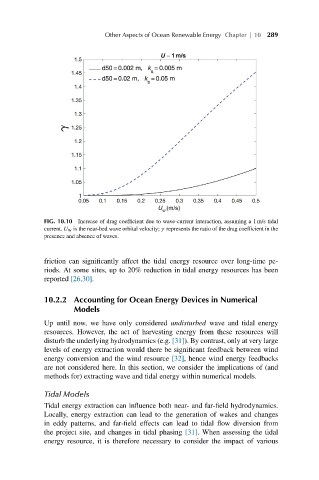
             FIG. 10.10  Increase of drag coefficient due to wave-current interaction, assuming a 1 m/s tidal
             current. U w is the near-bed wave orbital velocity; γ represents the ratio of the drag coefficient in the
             presence and absence of waves.


             friction can significantly affect the tidal energy resource over long-time pe-
             riods. At some sites, up to 20% reduction in tidal energy resources has been
             reported [26,30].


             10.2.2 Accounting for Ocean Energy Devices in Numerical
                     Models
             Up until now, we have only considered undisturbed wave and tidal energy
             resources. However, the act of harvesting energy from these resources will
             disturb the underlying hydrodynamics (e.g. [31]). By contrast, only at very large
             levels of energy extraction would there be significant feedback between wind
             energy conversion and the wind resource [32], hence wind energy feedbacks
             are not considered here. In this section, we consider the implications of (and
             methods for) extracting wave and tidal energy within numerical models.

             Tidal Models
             Tidal energy extraction can influence both near- and far-field hydrodynamics.
             Locally, energy extraction can lead to the generation of wakes and changes
             in eddy patterns, and far-field effects can lead to tidal flow diversion from
             the project site, and changes in tidal phasing [31]. When assessing the tidal
             energy resource, it is therefore necessary to consider the impact of various

