


Page 347 - Fundamentals of Radar Signal Processing
P. 347
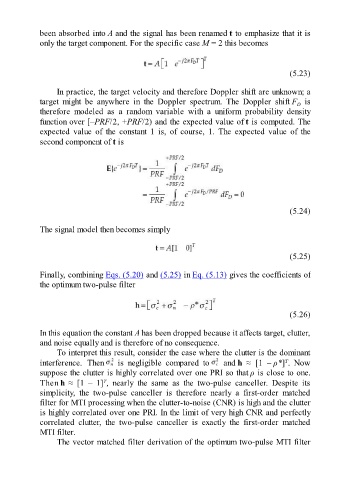
been absorbed into A and the signal has been renamed t to emphasize that it is
               only the target component. For the specific case M = 2 this becomes


                                                                                                       (5.23)


                     In practice, the target velocity and therefore Doppler shift are unknown; a

               target  might  be  anywhere  in  the  Doppler  spectrum.  The  Doppler  shift F   is
                                                                                                         D
               therefore  modeled  as  a  random  variable  with  a  uniform  probability  density
               function over [–PRF/2, +PRF/2) and the expected value of t is computed. The
               expected  value  of  the  constant  1  is,  of  course,  1.  The  expected  value  of  the
               second component of t is


                                                                                                       (5.24)

               The signal model then becomes simply


                                                                                                       (5.25)

               Finally, combining Eqs. (5.20) and (5.25) in Eq. (5.13) gives the coefficients of
               the optimum two-pulse filter


                                                                                                       (5.26)

               In this equation the constant A has been dropped because it affects target, clutter,
               and noise equally and is therefore of no consequence.

                     To interpret this result, consider the case where the clutter is the dominant
                                                                                                     T
               interference.  Then    is  negligible  compared  to    and h  ≈  [1  – ρ*] .  Now
               suppose the clutter is highly correlated over one PRI so that ρ is close to one.
                                     T
               Then h  ≈  [1  –  1] ,  nearly  the  same  as  the  two-pulse  canceller.  Despite  its
               simplicity,  the  two-pulse  canceller  is  therefore  nearly  a  first-order  matched

               filter for MTI processing when the clutter-to-noise (CNR) is high and the clutter
               is highly correlated over one PRI. In the limit of very high CNR and perfectly
               correlated  clutter,  the  two-pulse  canceller  is  exactly  the  first-order  matched
               MTI filter.
                     The vector matched filter derivation of the optimum two-pulse MTI filter

