


Page 535 - Fundamentals of Radar Signal Processing
P. 535
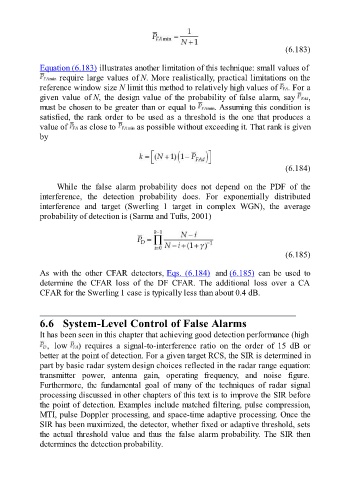
(6.183)

               Equation (6.183) illustrates another limitation of this technique: small values of
                      require large values of N. More realistically, practical limitations on the
               reference window size N limit this method to relatively high values of  . For a

               given  value  of N, the design value of the probability of false alarm, say                   ,
               must be chosen to be greater than or equal to                . Assuming this condition is
               satisfied, the rank order to be used as a threshold is the one that produces a
               value of   as close to            as possible without exceeding it. That rank is given
               by


                                                                                                     (6.184)

                     While  the  false  alarm  probability  does  not  depend  on  the  PDF  of  the
               interference,  the  detection  probability  does.  For  exponentially  distributed
               interference  and  target  (Swerling  1  target  in  complex  WGN),  the  average

               probability of detection is (Sarma and Tufts, 2001)


                                                                                                     (6.185)

               As  with  the  other  CFAR  detectors, Eqs. (6.184)  and (6.185)  can  be  used  to
               determine  the  CFAR  loss  of  the  DF  CFAR.  The  additional  loss  over  a  CA

               CFAR for the Swerling 1 case is typically less than about 0.4 dB.


               6.6   System-Level Control of False Alarms

               It has been seen in this chapter that achieving good detection performance (high
                  ,  low  )  requires  a  signal-to-interference  ratio  on  the  order  of  15  dB  or
               better at the point of detection. For a given target RCS, the SIR is determined in
               part by basic radar system design choices reflected in the radar range equation:

               transmitter  power,  antenna  gain,  operating  frequency,  and  noise  figure.
               Furthermore,  the  fundamental  goal  of  many  of  the  techniques  of  radar  signal
               processing discussed in other chapters of this text is to improve the SIR before
               the point of detection. Examples include matched filtering, pulse compression,
               MTI, pulse Doppler processing, and space-time adaptive processing. Once the
               SIR has been maximized, the detector, whether fixed or adaptive threshold, sets
               the  actual  threshold  value  and  thus  the  false  alarm  probability.  The  SIR  then

               determines the detection probability.

