


Page 539 - Fundamentals of Radar Signal Processing
P. 539
Variability,” IEEE Transactions on Aerospace and Electronic Systems,

                     vol. AES-36, no. 3, pp. 837–847, Jul. 2000.
               Taylor, J. W., “Receivers,” Chap. 3 in M. Skolnik (ed.), Radar Handbook, 2d
                     ed. McGraw-Hill, New York, 1990.
               Tufts, D. W., and A. J. Cann, “On Albersheim’s Detection Equation,” IEEE
                     Transactions on Aerospace and Electronic Systems, vol. AES-19, no. 4,
                     pp. 643–646, Jul. 1983.

               Van Cao, T.-T., “A CFAR Thresholding Approach Based on Test Cell
                     Statistics,” Proceedings of the 2004 IEEE Radar Conference, pp. 349–
                     354, Apr. 26–29, 2004.
               Van Trees, H. L., Detection, Estimation, and Modulation Theory, Part I:
                     Detection, Estimation, and Linear Modulation Theory. Wiley, New York,
                     1968.
               Weiner, M. A., “Binary Integration of Fluctuating Targets,” IEEE Transactions

                     on Aerospace and Electronic Systems, vol. AES-27, no. 1, pp. 11–17, Jan.
                     1991.
               Weiss, M., “Analysis of Some Modified Cell-Averaging CFAR Processors in
                     Multiple-Target Situations,” IEEE Transactions on Aerospace and
                     Electronic Systems, vol. AES-18, no. 1, pp. 102–114, Jan. 1982.


               Problems

                 1.  Consider a detection problem where under hypothesis H  the PDF of the
                                                                                       0
                     signal x is p (x | H ) = α·exp(–x/a), 0 ≤ x ≤ ∞, while under hypothesis H            1
                                          0
                                   x
                     the PDF of the signal x is p (x | H ) = β·exp(–x/β), 0 ≤ x ≤ ∞, with β > α.
                                                            1
                                                     x
                     What are the likelihood ratio and log likelihood ratio for this problem?
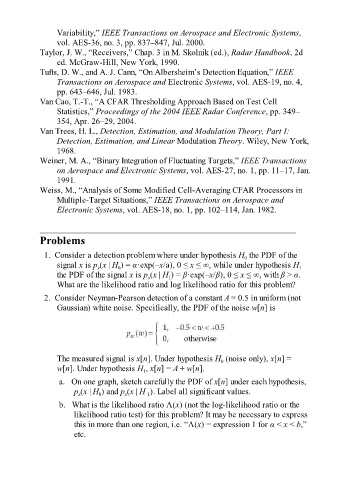
                 2.  Consider Neyman-Pearson detection of a constant A = 0.5 in uniform (not
                     Gaussian) white noise. Specifically, the PDF of the noise w[n] is


                       The measured signal is x[n]. Under hypothesis H  (noise only), x[n] =
                                                                               0
                     w[n]. Under hypothesis H , x[n] = A + w[n].
                                                   1
                        a.   On one graph, sketch carefully the PDF of x[n] under each hypothesis,
                           p (x | H ) and p (x | H  ). Label all significant values.
                                                     1
                                             x
                            x
                                    0
                        b.   What is the likelihood ratio Λ(x) (not the log-likelihood ratio or the
                           likelihood ratio test) for this problem? It may be necessary to express
                           this in more than one region, i.e. “Λ(x) = expression 1 for α < x < b,”
                           etc.

