


Page 541 - Fundamentals of Radar Signal Processing
P. 541
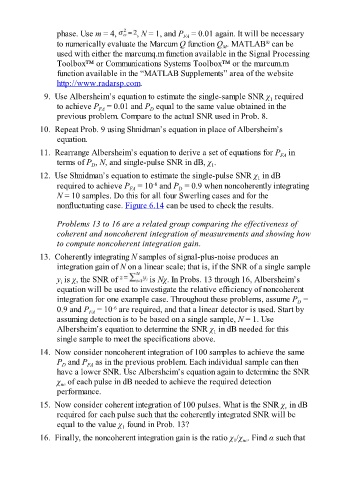
phase. Use m = 4,           , N = 1, and P  = 0.01 again. It will be necessary
                                                                 FA
                     to numerically evaluate the Marcum Q function Q . MATLAB  can be
                                                                                              ®
                                                                               M
                     used with either the marcumq.m function available in the Signal Processing
                     Toolbox™ or Communications Systems Toolbox™ or the marcum.m
                     function available in the “MATLAB Supplements” area of the website

                     http://www.radarsp.com.
                 9.  Use Albersheim’s equation to estimate the single-sample SNR χ  required
                                                                                                1
                     to achieve P  = 0.01 and P  equal to the same value obtained in the
                                    FA
                                                      D
                     previous problem. Compare to the actual SNR used in Prob. 8.
               10.  Repeat Prob. 9 using Shnidman’s equation in place of Albersheim’s
                     equation.

               11.  Rearrange Albersheim’s equation to derive a set of equations for P  in
                                                                                                   FA
                     terms of P , N, and single-pulse SNR in dB, χ .
                                 D
                                                                           1
               12.  Use Shnidman’s equation to estimate the single-pulse SNR χ  in dB
                                                                                           1
                     required to achieve P  = 10  and P  = 0.9 when noncoherently integrating
                                                       -8
                                              FA
                                                                D
                     N = 10 samples. Do this for all four Swerling cases and for the
                     nonfluctuating case. Figure 6.14 can be used to check the results.

                     Problems 13 to 16 are a related group comparing the effectiveness of
                     coherent and noncoherent integration of measurements and showing how

                     to compute noncoherent integration gain.

               13.  Coherently integrating N samples of signal-plus-noise produces an
                     integration gain of N on a linear scale; that is, if the SNR of a single sample
                     y  is χ, the SNR of              is Nχ. In Probs. 13 through 16, Albersheim’s
                      i
                     equation will be used to investigate the relative efficiency of noncoherent
                     integration for one example case. Throughout these problems, assume P  =
                                                                                                         D
                     0.9 and P  = 10  are required, and that a linear detector is used. Start by
                                        -6
                                FA
                     assuming detection is to be based on a single sample, N = 1. Use
                     Albersheim’s equation to determine the SNR χ  in dB needed for this
                                                                            1
                     single sample to meet the specifications above.
               14.  Now consider noncoherent integration of 100 samples to achieve the same

                     P  and P  as in the previous problem. Each individual sample can then
                                FA
                       D
                     have a lower SNR. Use Albersheim’s equation again to determine the SNR
                     χ  of each pulse in dB needed to achieve the required detection
                      nc
                     performance.

               15.  Now consider coherent integration of 100 pulses. What is the SNR χ  in dB
                                                                                                     c
                     required for each pulse such that the coherently integrated SNR will be
                     equal to the value χ  found in Prob. 13?
                                            1
               16.  Finally, the noncoherent integration gain is the ratio χ /χ . Find α such that
                                                                                   1
                                                                                      nc

