


Page 469 - Fundamentals of Water Treatment Unit Processes : Physical, Chemical, and Biological
P. 469
424                            Fundamentals of Water Treatment Unit Processes: Physical, Chemical, and Biological


                           Influent flow-containing body feed and particles  -to-be removed  Filter cake Pre-coat (3–5 mm)  Effluent-particles are  smaller than pore size  of filter cake  at the start of the filter run (McIndoe, 1969a, p. 51).
                                                               pre-coat also acts as an initial filtering media, which is effective
                                      filtered particles
                                    Body feed and
                                                               14.1.1.3.2
                                                                          Body Feed
                                                               Upon completion of the pre-coat, body feed is started, as
                                                               illustrated in Figure 14.2b. The body-feed tank is charged
                                                               with a mass of DE sufficient for operation for the expected
                                                               number of hours (i.e., before the headloss reaches a desig-
                                                               nated maximum). The slurry concentration should be high
                                                  Septum       enough that the tank size is not excessively large and low
             Diatoms                                           enough that the DE may be maintained in suspension. As in
            (bodyfeed)
                                                               the pre-coat tank, the DE in the body-feed tank is maintained
                Influent                            Effluent   as a slurry by means of a mixer (not high speed).
                                                                  The transition from the pre-coat phase to the body-feed
            Particles-to-                                      phase must be ‘‘smooth,’’ that is, without pressure shock to
            be removed
                                                               the pre-coat that has just been deposited. To attain the
                                                               smooth transition, the raw-water valve is opened slowly
                                                               while the valve from the pre-coat line is closed slowly; at
                           High pressure side  Low pressure side  the same time, the body feed is started and the effluent
                                                               valve from the tank-septum assembly is opened slowly.
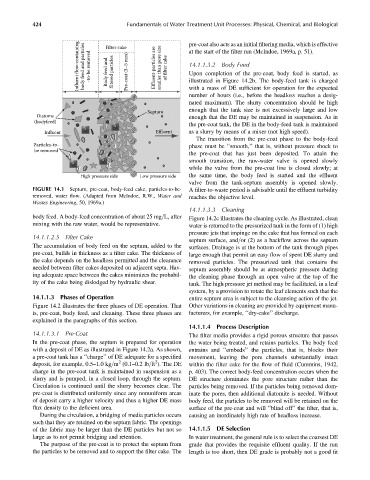
            FIGURE 14.1  Septum, pre-coat, body-feed cake, particles-to-be-  A filter-to-waste period is advisable until the effluent turbidity
            removed, water flow. (Adapted from McIndoe, R.W., Water and  reaches the objective level.
            Wastes Engineering, 50, 1969a.)
                                                               14.1.1.3.3  Cleaning
            body feed. A body-feed concentration of about 25 mg=L, after  Figure 14.2c illustrates the cleaning cycle. As illustrated, clean
            mixing with the raw water, would be representative.  water is returned to the pressurized tank in the form of (1) high
                                                               pressure jets that impinge on the cake that has formed on each
            14.1.1.2.5  Filter Cake
                                                               septum surface, and=or (2) as a backflow across the septum
            The accumulation of body feed on the septum, added to the  surfaces. Drainage is at the bottom of the tank through pipes
            pre-coat, builds in thickness as a filter cake. The thickness of  large enough that permit an easy flow of spent DE slurry and
            the cake depends on the headloss permitted and the clearance  removed particles. The pressurized tank that contains the
            needed between filter cakes deposited on adjacent septa. Hav-  septum assembly should be at atmospheric pressure during
            ing adequate space between the cakes minimizes the probabil-  the cleaning phase through an open valve at the top of the
            ity of the cake being dislodged by hydraulic shear.  tank. The high pressure jet method may be facilitated, in a leaf
                                                               system, by a provision to rotate the leaf elements such that the
            14.1.1.3  Phases of Operation                      entire septum area is subject to the cleansing action of the jet.
            Figure 14.2 illustrates the three phases of DE operation. That  Other variations in cleaning are provided by equipment manu-
            is, pre-coat, body feed, and cleaning. These three phases are  facturers, for example, ‘‘dry-cake’’ discharge.
            explained in the paragraphs of this section.
                                                               14.1.1.4  Process Description
            14.1.1.3.1  Pre-Coat                               The filter media provides a rigid porous structure that passes
            In the pre-coat phase, the septum is prepared for operation  the water being treated, and retains particles. The body feed
            with a deposit of DE as illustrated in Figure 14.2a. As shown,  entrains and ‘‘embeds’’ the particles, that is, blocks their
            a pre-coat tank has a ‘‘charge’’ of DE adequate for a specified  movement, leaving the pore channels substantially intact
                                        2
                                                    2
            deposit, for example, 0.5–1.0 kg=m (0.1–0.2 lb=ft ). The DE  within the filter cake for the flow of fluid (Cummins, 1942,
            charge in the pre-coat tank is maintained in suspension as a  p. 403). The correct body-feed concentration occurs when the
            slurry and is pumped, in a closed loop, through the septum.  DE structure dominates the pore structure rather than the
            Circulation is continued until the slurry becomes clear. The  particles being removed. If the particles being removed dom-
            pre-coat is distributed uniformly since any nonuniform areas  inate the pores, then additional diatomite is needed. Without
            of deposit carry a higher velocity and thus a higher DE mass  body feed, the particles to be removed will be retained on the
            flux density to the deficient area.                  surface of the pre-coat and will ‘‘blind off’’ the filter, that is,
              During the circulation, a bridging of media particles occurs  causing an inordinately high rate of headloss increase.
            such that they are retained on the septum fabric. The openings
            of the fabric may be larger than the DE particles but not so  14.1.1.5  DE Selection
            large as to not permit bridging and retention.     In water treatment, the general rule is to select the coarsest DE
              The purpose of the pre-coat is to protect the septum from  grade that provides the requisite effluent quality. If the run
            the particles to be removed and to support the filter cake. The  length is too short, then DE grade is probably not a good fit

