


Page 562 - Fundamentals of Water Treatment Unit Processes : Physical, Chemical, and Biological
P. 562
Ion-Exchange                                                                                     517


                                                                                                    —
                                                                                                  HC      CH 2
                                                                                                    —
                     H                       Vinyl group
               H     C     H                          HC       CH 2  — CH — CH  — CH — CH  — CH  — CH
                                                         —
                                                         —
                  C      C                                              2        2    2
                  C      C
                                                                                                    —
                                                                                                    —
               H     C                                                                            HC      CH 2
                            H
               (a)   H                        (b)              (c)                           (d)
                                                                 Styrene
                                                                           — CH — CH —
                                                                 — CH — CH 2      2

                                 — CH — CH — CH — CH —                                 DVB
                                                  2
                                         2
                                                        DVB

                                                                   SO H   — CH—CH  — CH — CH —
                                                                                 2
                                                                                           2
                                                                     3
                                                               Sulfonic acid
                                        — CH — CH — CH — CH —  group with H +
                                                2
                                                         2
                                                                counter ion
                               (e)   Styrene                  (f)                   SO H
                                                                                      3
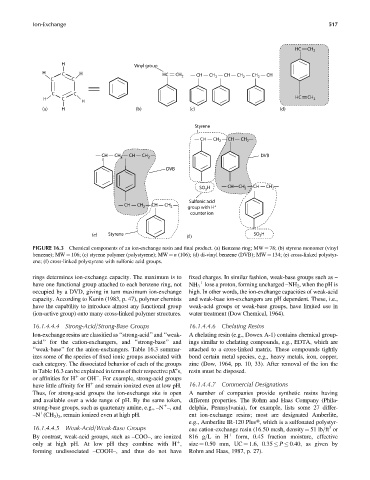
            FIGURE 16.3  Chemical components of an ion-exchange resin and final product. (a) Benzene ring; MW ¼ 78; (b) styrene monomer (vinyl
            benzene); MW ¼ 106; (c) styrene polymer (polystyrene); MW ¼ n (106); (d) di-vinyl benzene (DVB); MW ¼ 134; (e) cross-linked polystyr-
            ene; (f) cross-linked polystyrene with sulfonic acid groups.

            rings determines ion-exchange capacity. The maximum is to  fixed charges. In similar fashion, weak-base groups such as –
            have one functional group attached to each benzene ring, not  NH 3 lose a proton, forming uncharged –NH 2 , when the pH is
                                                                   þ
            occupied by a DVD, giving in turn maximum ion-exchange  high. In other words, the ion-exchange capacities of weak-acid
            capacity. According to Kunin (1983, p. 47), polymer chemists  and weak-base ion-exchangers are pH dependent. These, i.e.,
            have the capability to introduce almost any functional group  weak-acid groups or weak-base groups, have limited use in
            (ion-active group) onto many cross-linked polymer structures.  water treatment (Dow Chemical, 1964).
            16.1.4.4.4  Strong-Acid=Strong-Base Groups         16.1.4.4.6  Chelating Resins
            Ion-exchange resins are classified as ‘‘strong-acid’’ and ‘‘weak-  A chelating resin (e.g., Dowex A-1) contains chemical group-
            acid’’ for the cation-exchangers, and ‘‘strong-base’’ and  ings similar to chelating compounds, e.g., EDTA, which are
            ‘‘weak-base’’ for the anion-exchangers. Table 16.3 summar-  attached to a cross-linked matrix. These compounds tightly
            izes some of the species of fixed ionic groups associated with  bond certain metal species, e.g., heavy metals, iron, copper,
            each category. The dissociated behavior of each of the groups  zinc (Dow, 1964, pp. 10, 33). After removal of the ion the
            in Table 16.3 can be explained in terms of their respective pK’s,  resin must be disposed.
            or affinities for H or OH . For example, strong-acid groups
                          þ

            have little affinity for H and remain ionized even at low pH.  16.1.4.4.7  Commercial Designations
                               þ
            Thus, for strong-acid groups the ion-exchange site is open  A number of companies provide synthetic resins having
            and available over a wide range of pH. By the same token,  different properties. The Rohm and Haas Company (Phila-
            strong-base groups, such as quartenary amine, e.g., –N –, and  delphia, Pennsylvania), for example, lists some 27 differ-
                                                       þ
            –N (CH 3 ) 3 , remain ionized even at high pH.     ent ion-exchange resins; most are designated Amberlite,
              þ
                                                               e.g., Amberlite IR-120 Plust, which is a sulfonated polystyr-
            16.1.4.4.5  Weak-Acid=Weak-Base Groups             ene cation-exchange resin (16.50 mesh, density ¼ 51 lb=ft or
                                                                                                             3
            By contrast, weak-acid groups, such as –COO–, are ionized  816 g=LinH þ  form, 0.45 fraction moisture, effective
            only at high pH. At low pH they combine with H ,   size ¼ 0.50 mm, UC ¼ 1.6, 0.35   P   0.40, as given by
                                                           þ
            forming undissociated –COOH–, and thus do not have  Rohm and Haas, 1987, p. 27).

