


Page 727 - Fundamentals of Water Treatment Unit Processes : Physical, Chemical, and Biological
P. 727
682                            Fundamentals of Water Treatment Unit Processes: Physical, Chemical, and Biological


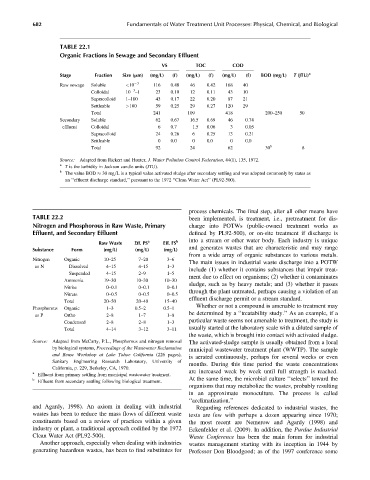
                     TABLE 22.1
                     Organic Fractions in Sewage and Secondary Effluent
                                                      VS         TOC          COD
                     Stage      Fraction  Size (mm)  (mg=L)  (f)  (mg=L)  (f)  (mg=L)  (f)  BOD (mg=L)  T (JTU) a
                     Raw sewage  Soluble  <10  3   116   0.48   46   0.42  168   40
                                             3
                               Colloidal  10 –1     23   0.10   12   0.11   43   10
                               Supracolloid  1–100  43   0.17   22   0.20   87   21
                               Settleable  >100     59   0.25   29   0.27  120   29
                               Total               241         109         418          200–250     50
                     Secondary  Soluble             62   0.67   16.5  0.69  46    0.74
                      effluent  Colloidal             6   0.7    1.5  0.06    3    0.05
                               Supracolloid         24   0.26   6    0.25   13    0.21
                               Settleable            0   0.0    0    0.0     0    0.0
                               Total                92          24          62          30 b        8
                     Source: Adapted from Rickert and Hunter, J. Water Pollution Control Federation, 44(1), 135, 1972.
                     a
                      T is the turbidity in Jackson candle units (JTU).
                     b
                       The value BOD   30 mg=L is a typical value activated sludge after secondary settling and was adopted commonly by states as
                       an ‘‘effluent discharge standard,’’ pursuant to the 1972 ‘‘Clean Water Act’’ (PL92-500).


                                                               process chemicals. The final step, after all other means have
            TABLE 22.2                                         been implemented, is treatment, i.e., pretreatment for dis-
            Nitrogen and Phosphorous in Raw Waste, Primary     charge into POTWs (public-owned treatment works as
            Effluent, and Secondary Effluent                     defined by PL92-500), or on-site treatment if discharge is

                                 Raw Waste   Eff. PS a  Eff. FS b  into a stream or other water body. Each industry is unique
                                                               and generates wastes that are characteristic and may range
            Substance    Form      (mg=L)     (mg=L)   (mg=L)
                                                               from a wide array of organic substances to various metals.
            Nitrogen  Organic      10–25       7–20     3–6
                                                               The main issues in industrial waste discharge into a POTW
             as N       Dissolved   4–15       4–15     1–3
                                                               include (1) whether it contains substances that impair treat-
                        Suspended   4–15       2–9      1–5
                                                               ment due to effect on organisms; (2) whether it contaminates
                      Ammonia      19–30      10–30    10–30
                                                               sludge, such as by heavy metals; and (3) whether it passes
                      Nitrite       0–0.1      0–0.1    0–0.1
                                                               through the plant untreated, perhaps causing a violation of an
                      Nitrate       0–0.5      0–0.5    0–0.5
                                                               effluent discharge permit or a stream standard.
                      Total        20–50      20–40    15–40
                                                                  Whether or not a compound is amenable to treatment may
            Phosphorous  Organic    1–3      0.5–2     0.5–1
                                                               be determined by a ‘‘treatability study.’’ As an example, if a
             as P     Ortho         2–8        1–7      1–8
                      Condensed     2–8        2–8      1–3    particular waste seems not amenable to treatment, the study is
                      Total         4–14       3–12     3–11   usually started at the laboratory scale with a diluted sample of
                                                               the waste, which is brought into contact with activated sludge.
            Source: Adapted from McCarty, P.L., Phosphorous and nitrogen removal  The activated-sludge sample is usually obtained from a local
                  by biological systems, Proceedings of the Wastewater Reclamation  municipal wastewater treatment plant (WWTP). The sample
                  and Reuse Workshop at Lake Tahoe California (226 pages),
                                                               is aerated continuously, perhaps for several weeks or even
                  Sanitary  Engineering  Research  Laboratory,  University  of
                                                               months. During this time period the waste concentrations
                  California, p. 229, Berkeley, CA, 1970.
            a                                                  are increased week by week until full strength is reached.
             Effluent from primary settling from municipal wastewater treatment.
            b                                                  At the same time, the microbial culture ‘‘selects’’ toward the
              Effluent from secondary settling following biological treatment.
                                                               organisms that may metabolize the wastes, probably resulting
                                                               in an approximate monoculture. The process is called
                                                               ‘‘acclimatization.’’
            and Agardy, 1998). An axiom in dealing with industrial  Regarding references dedicated to industrial wastes, the
            wastes has been to reduce the mass flows of different waste  texts are few with perhaps a dozen appearing since 1970;
            constituents based on a review of practices within a given  the most recent are Nemerow and Agardy (1998) and
            industry or plant, a traditional approach codified by the 1972  Eckenfelder et al. (2009). In addition, the Purdue Industrial
            Clean Water Act (PL92-500).                        Waste Conference has been the main forum for industrial
              Another approach, especially when dealing with industries  wastes management starting with its inception in 1944 by
            generating hazardous wastes, has been to find substitutes for  Professor Don Bloodgood; as of the 1997 conference some

