


Page 730 - Fundamentals of Water Treatment Unit Processes : Physical, Chemical, and Biological
P. 730
Biological Reactions and Kinetics                                                                685


                CH 3          CH 3                             molecular oxygen. In an ‘‘anoxic’’ reaction, nitrate may serve
                                                               but with a lower yield of ATP.
                j              j
                CHOH     $     CH¼O þ 2H þ 2e           (22:1)
                                           þ
                                                               22.2.1.1.2  ATP Energy Yields
                j              j
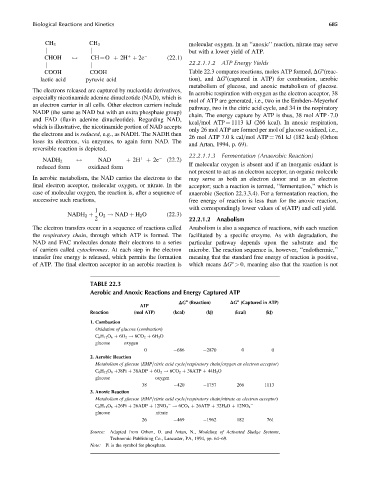
                COOH           COOH                            Table 22.3 compares reactions, moles ATP formed, DG8(reac-
              lactic acid    pyruvic acid                      tion), and DG8(captured in ATP) for combustion, aerobic
                                                               metabolism of glucose, and anoxic metabolism of glucose.
            The electrons released are captured by nucleotide derivatives,
                                                               In aerobic respiration with oxygen as the electron acceptor, 38
            especially nicotinamide adenine dinucleotide (NAD), which is
                                                               mol of ATP are generated, i.e., two in the Embden–Meyerhof
            an electron carrier in all cells. Other electron carriers include
                                                               pathway, two in the citric acid cycle, and 34 in the respiratory
            NADP (the same as NAD but with an extra phosphate group)
                                                               chain. The energy capture by ATP is thus, 38 mol ATP   7.0
            and FAD (flavin adenine dinucleotide). Regarding NAD,
                                                               kcal=mol ATP ¼ 1113 kJ (266 kcal). In anoxic respiration,
            which is illustrative, the nicotinamide portion of NAD accepts
                                                               only 26 mol ATP are formed per mol of glucose oxidized, i.e.,
            the electrons and is reduced, e.g., as NADH. The NADH then
                                                               26 mol ATP 7.0 k cal=mol ATP ¼ 761 kJ (182 kcal) (Orhon
            loses its electrons, via enzymes, to again form NAD. The
                                                               and Artan, 1994, p. 69).
            reversible reaction is depicted,
                                                               22.2.1.1.3  Fermentation (Anaerobic Reaction)
               NADH 2     $      NAD       þ 2H þ 2e    (22:2)
                                               þ
                                                               If molecular oxygen is absent and if an inorganic oxidant is
             reduced form     oxidized form
                                                               not present to act as an electron acceptor, an organic molecule
            In aerobic metabolism, the NAD carries the electrons to the  may serve as both an electron donor and as an electron
            final electron acceptor, molecular oxygen, or nitrate. In the  acceptor; such a reaction is termed, ‘‘fermentation,’’ which is
            case of molecular oxygen, the reaction is, after a sequence of  anaerobic (Section 22.3.3.4). For a fermentation reaction, the
            successive such reactions,                         free energy of reaction is less than for the anoxic reaction,
                                                               with correspondingly lower values of n(ATP) and cell yield.
                                1
                       NADH 2 þ O 2 ! NAD þ H 2 O       (22:3)
                                2                              22.2.1.2  Anabolism
            The electron transfers occur in a sequence of reactions called  Anabolism is also a sequence of reactions, with each reaction
            the respiratory chain, through which ATP is formed. The  facilitated by a specific enzyme. As with degradation, the
            NAD and FAC molecules donate their electrons to a series  particular pathway depends upon the substrate and the
            of carriers called cytochromes. At each step in the electron  microbe. The reaction sequence is, however, ‘‘endothermic,’’
            transfer free energy is released, which permits the formation  meaning that the standard free energy of reaction is positive,
            of ATP. The final electron acceptor in an aerobic reaction is  which means DG8 > 0, meaning also that the reaction is not

                               TABLE 22.3
                               Aerobic and Anoxic Reactions and Energy Captured ATP
                                                              o
                                                                               o
                                                            DG (Reaction)    DG (Captured in ATP)
                                               ATP
                               Reaction      (mol ATP)    (kcal)     (kJ)     (kcal)    (kJ)
                               1. Combustion
                                Oxidation of glucose (combustion)
                                C 6 H 12 O 6 þ 6O 2 ! 6CO 2 þ 6H 2 O
                                glucose   oxygen
                                                 0         686       2870        0        0
                               2. Aerobic Reaction
                                Metabolism of glucose (EMP=citric acid cycle=respiratory chain=oxygen as electron acceptor)
                                C 6 H 12 O 6 þ38Pi þ 38ADP þ 6O 2 ! 6CO 2 þ 38ATP þ 44H 2 O
                                glucose             oxygen
                                                38         420       1757      266      1113
                               3. Anoxic Reaction
                                Metabolism of glucose (EMP=citric acid cycle=respiratory chain=nitrate as electron acceptor)

                                C 6 H 12 O 6 þ26Pi þ 26ADP þ 12NO 3 ! 6CO 2 þ 26ATP þ 32H 2 O þ 12NO 2
                                glucose             nitrate
                                                26         469       1962      182       761
                               Source: Adapted from Orhon, D. and Artan, N., Modeling of Activated Sludge Systems,
                                     Technomic Publishing Co., Lancaster, PA, 1994, pp. 64–69.
                               Note: Pi is the symbol for phosphate.

