


Page 731 - Fundamentals of Water Treatment Unit Processes : Physical, Chemical, and Biological
P. 731
686                            Fundamentals of Water Treatment Unit Processes: Physical, Chemical, and Biological


                   Level of organization    Examples           22.2.1.4  Photosynthesis
                         Cells         Bacteria                The empirical cell formula for an algae biomass is
                                       Algae                   C 7.6 H 8.1 O 2.5 N. An associated photosynthesis reaction is
                                       Fungi
                                       Protozoa                (Benefield and Randall, 1980, p. 326)
                       Organelles      Nuclei
                                                                  7:6CO 2 þ 2:5H 2 O þ NH 3 ! C 7:6 H 8:1 O 2:5 N þ 7:6O 2
                                       Mitochondria
                                       Ribosomes                                                           (22:4)
                                       Flagella
                                                               The reaction is proportional to the radiant energy and varies
                  Supramolecular systems  Membranes
                                       Enzymes                 diurnally. In monitoring dissolved oxygen (DO) concentra-
                                                               tions over 24 h cycles, Kartchner et al. (1969) found an
                     Macromolecules    Nucleic acids           approximate sinusoidal variation during daylight hours. The
                                       Proteins                oxygen produced has been considered a source for the aerobic
                                       Polysaccharides
                                       Lipids                  treatment of wastewaters, such as in ponds. At the same time,
                                                               the algae biomass ‘‘respires’’ and has an oxygen demand,
                 Monomers or building blocks  Nucleotides
                                       Amino acids             which reduces the DO concentration after sunset with a steady
                                       Sugars                  decline until sunrise. The DO concentrations may reach levels
                                       Fatty acids             in the range of 30–40 mg=L in some stagnant waters and as
                                                     3–
                    Inorganic molecules  CO , NH 3 , H 2 O, PO 4 xx  high as 16 mg=L in fast-moving mountain streams. At night the
                                          2
                                                               stagnant waters are likely to go ‘‘anoxic.’’ Observations in a
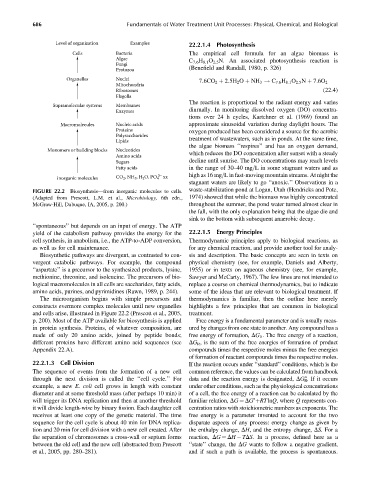
            FIGURE 22.2  Biosynthesis—from inorganic molecules to cells.  waste-stabilization pond at Logan, Utah (Hendricks and Pote,
            (Adapted from Prescott, L.M. et al., Microbiology, 6th edn.,  1974) showed that while the biomass was highly concentrated
            McGraw-Hill, Dubuque, IA, 2005, p. 200.)           throughout the summer, the pond water turned almost clear in
                                                               the fall, with the only explanation being that the algae die and
                                                               sink to the bottom with subsequent anaerobic decay.
            ‘‘spontaneous’’ but depends on an input of energy. The ATP
            yield of the catabolism pathway provides the energy for the  22.2.1.5  Energy Principles
            cell synthesis, in anabolism, i.e., the ATP-to-ADP conversion,  Thermodynamic principles apply to biological reactions, as
            as well as for cell maintenance.                   for any chemical reaction, and provide another tool for analy-
              Biosynthetic pathways are divergent, as contrasted to con-  sis and description. The basic concepts are seen in texts on
            vergent catabolic pathways. For example, the compound  physical chemistry (see, for example, Daniels and Alberty,
            ‘‘aspartate’’ is a precursor to the synthesized products, lysine,  1955) or in texts on aqueous chemistry (see, for example,
            methionine, threonine, and isoleucine. The precursors of bio-  Sawyer and McCarty, 1967). The few lines are not intended to
            logical macromolecules in all cells are saccharides, fatty acids,  replace a course on chemical thermodynamics, but to indicate
            amino acids, purines, and pyrimidines (Rawn, 1989, p. 244).  some of the ideas that are relevant to biological treatment. If
              The microorganism begins with simple precursors and  thermodynamics is familiar, then the outline here merely
            constructs evermore complex molecules until new organelles  highlights a few principles that are common in biological
            and cells arise, illustrated in Figure 22.2 (Prescott et al., 2005,  treatment.
            p. 200). Most of the ATP available for biosynthesis is applied  Free energy is a fundamental parameter and is usually meas-
            in protein synthesis. Proteins, of whatever composition, are  ured by changes from one state to another. Any compound has a
            made of only 20 amino acids, joined by peptide bonds;  free energy of formation, DG f ,. The free energy of a reaction,
            different proteins have different amino acid sequences (see  DG R , is the sum of the free energies of formation of product
            Appendix 22.A).                                    compounds times the respective moles minus the free energies
                                                               of formation of reactant compounds times the respective moles.
            22.2.1.3  Cell Division                            If the reaction occurs under ‘‘standard’’ conditions, which is the
            The sequence of events from the formation of a new cell  common reference, the values can be calculated from handbook
            through the next division is called the ‘‘cell cycle.’’ For  data and the reaction energy is designated, DG R 8.If it occurs
            example, a new E. coli cell grows in length with constant  under other conditions, such as the physiological concentrations
            diameter and at some threshold mass (after perhaps 10 min) it  of a cell, the free energy of a reaction can be calculated by the
            will trigger its DNA replication and then at another threshold  familiar relation, DG ¼ DG8þRTlnQ,where Q represents con-
            it will divide length-wise by binary fission. Each daughter cell  centration ratios with stoichiometric numbers as exponents. The
            receives at least one copy of the genetic material. The time  free energy is a parameter invented to account for the two
            sequence for the cell cycle is about 40 min for DNA replica-  disparate aspects of any process: energy change as given by
            tion and 20 min for cell division with a new cell created. After  the enthalpy change, DH, and the entropy change, DS.For a
            the separation of chromosomes a cross-wall or septum forms  reaction, DG ¼ DH   TDS. In a process, defined here as a
            between the old cell and the new cell (abstracted from Prescott  ‘‘state’’ change, the DG wants to follow a negative gradient,
            et al., 2005, pp. 280–281).                        and if such a path is available, the process is spontaneous.

