


Page 899 - Fundamentals of Water Treatment Unit Processes : Physical, Chemical, and Biological
P. 899
854                                                                        Appendix H: Dissolved Gases


                                  120
                                  110
                                  100
                                Atmospheric pressure (kPa)  70  Y=M0+M1*x +   M8*x +M9*x  9
                                  90
                                  80
                                                  ...
                                                       8
                                                     101.3
                                          M0
                                  60
                                          M1
                                                    –0.011944
                                  50
                                          M2
                                                    5.3142e-07
                                  40
                                          M4
                                                    8.246e-15
                                  30
                                                   –2.3906e-18
                                          M5
                                  20      M3       –1.3476e-11
                                          M6        2.0382e-22
                                  10       R           1
                                   0
                                     0    500  1000  1500  2000  2500  3000  3500  4000  4500  5000
                                                            Elevation (m)
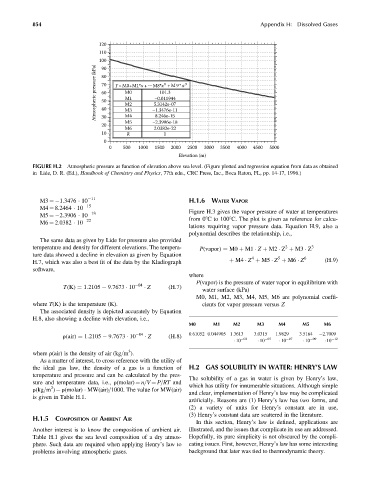
            FIGURE H.2 Atmospheric pressure as function of elevation above sea level. (Figure plotted and regression equation from data as obtained
            in Lide, D. R. (Ed.), Handbook of Chemistry and Physics, 77th edn., CRC Press, Inc., Boca Raton, FL, pp. 14-17, 1996.)
              M3 ¼ 1.3476   10  11                             H.1.6 WATER VAPOR
              M4 ¼ 8.2464   10  15                             Figure H.3 gives the vapor pressure of water at temperatures
              M5 ¼ 2.3906   10  18                             from 08C to 1008C. The plot is given as reference for calcu-
              M6 ¼ 2.0382   10  22
                                                               lations requiring vapor pressure data. Equation H.9, also a
                                                               polynomial describes the relationship, i.e.,
              The same data as given by Lide for pressure also provided
            temperature and density for different elevations. The tempera-  P(vapor) ¼ M0 þ M1   Z þ M2   Z þ M3   Z 3
                                                                                               2
            ture data showed a decline in elevation as given by Equation            4       5        6
            H.7, which was also a best fit of the data by the Kladiograph    þ M4   Z þ M5   Z þ M6   Z      (H:9)
            software,
                                                               where
                                                                  P(vapor) is the pressure of water vapor in equilibrium with
                      T(K) ¼ 1:2105   9:7673   10  04    Z  (H:7)
                                                                    water surface (kPa)
                                                                  M0, M1, M2, M3, M4, M5, M6 are polynomial coeffi-
            where T(K) is the temperature (K).                      cients for vapor pressure versus Z
              The associated density is depicted accurately by Equation
            H.8, also showing a decline with elevation, i.e.,
                                                               M0      M1     M2      M3     M4      M5     M6

                      r(air) ¼ 1:2105   9:7673   10  04    Z  (H:8)  0.61052 0.044905 1.3613  3.0315  1.9829  3.5164   2.7009
                                                                                10  03    10  05    10  07    10  09    10  12
                                           3
            where r(air) is the density of air (kg=m ).
              As a matter of interest, to cross reference with the utility of
            the ideal gas law, the density of a gas is a function of  H.2 GAS SOLUBILITY IN WATER: HENRY’S LAW
            temperature and pressure and can be calculated by the pres-
                                                               The solubility of a gas in water is given by Henry’s law,
            sure and temperature data, i.e., r(molar) ¼ n=V ¼ P=RT and
                  3                                            which has utility for innumerable situations. Although simple
            r(kg=m ) ¼ r(molar)   MW(air)=1000. The value for MW(air)
                                                               and clear, implementation of Henry’s law may be complicated
            is given in Table H.1.
                                                               artificially. Reasons are (1) Henry’s law has two forms, and
                                                               (2) a variety of units for Henry’s constant are in use,
                                                               (3) Henry’s constant data are scattered in the literature.
            H.1.5  COMPOSITION OF AMBIENT AIR
                                                                  In this section, Henry’s law is defined, applications are
            Another interest is to know the composition of ambient air.  illustrated, and the issues that complicate its use are addressed.
            Table H.1 gives the sea level composition of a dry atmos-  Hopefully, its pure simplicity is not obscured by the compli-
            phere. Such data are required when applying Henry’s law to  cating issues. First, however, Henry’s law has some interesting
            problems involving atmospheric gases.              background that later was tied to thermodynamic theory.

