


Page 122 - Gas Purification 5E
P. 122
1 12   Gas Pur$cation


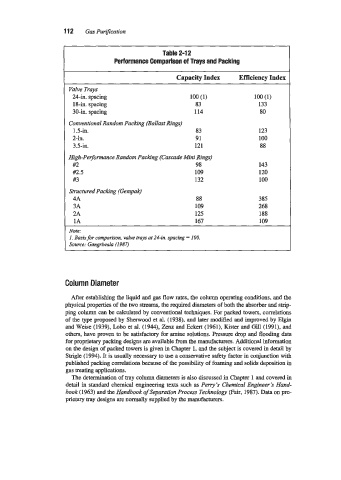
                                                 Table 2-12
                                   Performance Comparison of Trays and Packing

                                                      Capacity Index    Efficiency Index
                      Valve Trays
                       %-in.  spacing                     100 (1)            100 (1)
                       18-in. spacing                      83                 133
                       30-in. spacing                      114                80
                      Conventional Random Packing (Ballast Rings)
                       1.5-in.                             83                 123
                       2-in.                               91                 100
                       3.5-in.                             121                88
                      High-Performance Random Packing (Cascade Mini Rings)
                       #2                                  98                 143
                       a.5                                 109                120
                       #3                                  132                100
                      Structured Packing (Gempak)
                       4A                                  88                 385
                       3A                                  109                268
                       2A                                  125                188
                       1A                                  167                109
                      Note:
                      I. Basis for comparison. valve trays at 24-in. spacing = 100.
                      Source: Gangriwala (1987)


                     Column Diameter

                      After establishing the liquid and gas flow rates, the column operating conditions, and the
                    physical properties of the two streams, the required diameters of both the absorber and strip-
                    ping column can be calculated by conventional techniques. For packed towers, correlations
                     of the type proposed by  Sherwood et al. (1938), and later modified and improved by Elgin
                     and Weise (1939): Lobo et al. (1944), Zenz and Eckert (1961), Kister and Gill (1991), and
                     others, have proven to be satisfactory for amine solutions. Pressure drop and flooding data
                     for proprietary packing designs are available from the manufacturers. Additional information
                     on the design of packed towers is given in Chapter 1, and the subject is covered in detail by
                     Smgle (1994). It is usually necessary to use a conservative safety factor in conjunction with
                     published packing correlations because of the possibility of foaming and solids deposition in
                     gas treating applications.
                      The determination of tray column diameters is also discussed in Chapter 1 and covered in
                     detail in standard chemical engineering texts such as Perry’s Chemical Engineer’s Hand-
                     book (1963) and the Handbook ofseparation Process Technology (Fair, 1987). Data on pro-
                     prietary tray designs are normally supplied by the manufacturers.

